The Emerald Trim House at the Woodland Edge
Hidden where a quiet residential street dissolves into mature woodland, an abandoned Eastlake Victorian family house quietly endures beneath towering oaks and pines. Once a proud expression of Victorian craftsmanship, the three-story residence now exists in a state of gentle decline, its ornate architectural details softened by decades of weather, silence, and the slow return of nature.
Built from crisp white-painted brick resting on warm russet red sandstone foundations, the house immediately stands apart through its elegant contrast of colors and textures. Rich emerald-green trim outlines every gable, window, porch column, and bracket, creating striking definition even beneath layers of peeling paint. The sandstone base remains remarkably solid, though softened by moss, dampness, and time.
The Eastlake character is expressed in extraordinary detail. Elaborate sunburst spindlework fills the porch friezes with delicate geometric patterns, while deeply carved wooden brackets support generous roof overhangs. Tall faceted bay windows project from the façade, each crowned by beautifully weathered stained-glass transoms that still catch the muted daylight despite years of abandonment.
Perhaps the home’s most recognizable feature is its slender octagonal turret, rising elegantly from one corner of the structure. Its weathered copper cap has transformed into a rich verdigris green that echoes the surrounding forest canopy. Time has encouraged the tower into a subtle lean, giving it the appearance of slowly settling toward the trees that now surround it.
Rather than rigid symmetry, the house displays the gentle imperfections that accumulate over generations. Exterior walls bulge almost imperceptibly between floors, window spacing drifts slightly from perfect alignment, and portions of the wraparound porch have sagged gracefully beneath decades of seasonal weight. The porch itself sweeps around a rounded corner, its railings wrapped in climbing ivy that threads through broken balusters and weathered columns.
Roof ridges have become soft green lines beneath thick carpets of moss. Several shutters hang crooked from rusted hinges, swaying only when woodland breezes reach the quiet street. Paint has lifted from the emerald trim in broad curling flakes, revealing older generations of color beneath while preserving the remarkable craftsmanship carved into every surface.
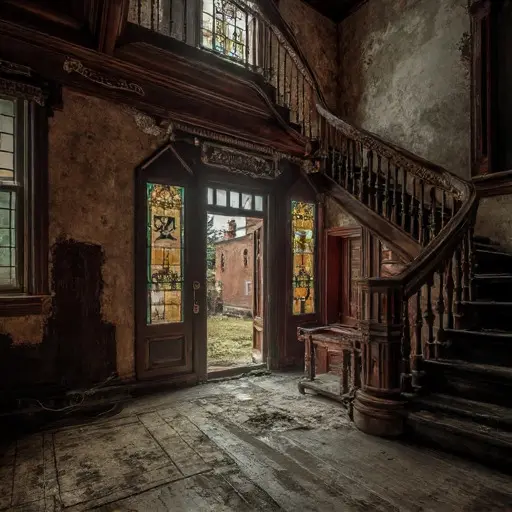
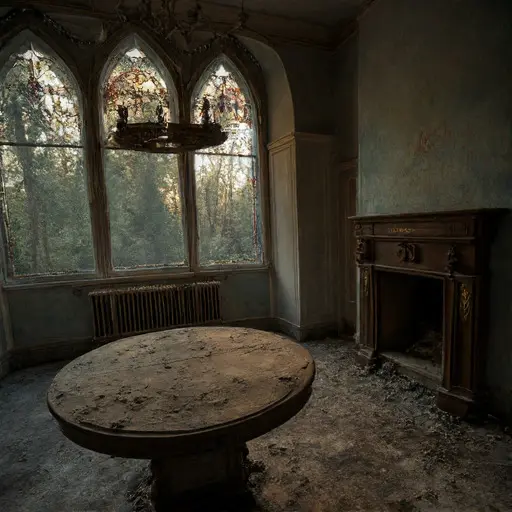
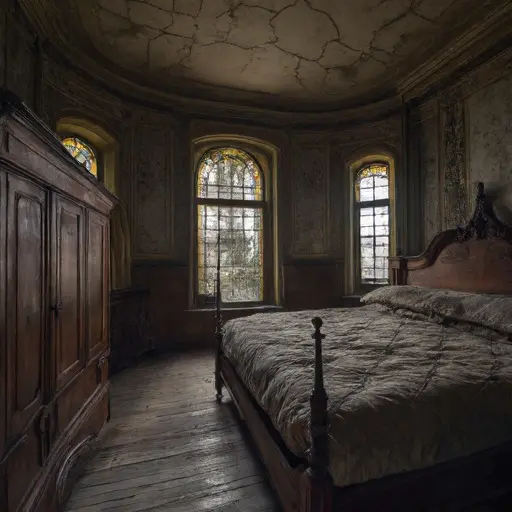
Inside, the home retains an atmosphere of refined abandonment. Decorative woodwork still frames wide openings between rooms, while elaborate ceiling moldings remain surprisingly intact despite years of neglect. Dust settles evenly across polished surfaces that have long since lost their shine, creating quiet spaces filled only with filtered daylight and silence.
Beyond the walls, nature has gradually reclaimed the property with remarkable patience. Moss-covered stone walls disappear beneath dense ferns, while abandoned flower beds blend seamlessly into the surrounding woodland. Towering oak and pine trees cast an even canopy over the property, allowing only soft diffused daylight to reach the overgrown gardens.
A faded clothesline still stretches between two old maple trees, supporting weathered family laundry left untouched by countless seasons. Nearby, a cracked stone fountain holds perfectly still reflective water, mirroring grey skies, surrounding ferns, and the quiet silhouette of the house without a ripple.
The overgrown brick walkway leading toward the porch has nearly disappeared beneath moss and wild vegetation. Individual bricks remain visible only where decades of footsteps once wore smooth paths toward the entrance. Ivy climbs porch columns, disappears beneath railings, and reaches toward second-story windows, slowly weaving the architecture into the surrounding forest.
Although abandoned, the house possesses none of the violence of sudden ruin. Instead, it reflects the gradual transformation that occurs when architecture and landscape quietly negotiate ownership over many decades. Every softened wall, leaning turret, moss-covered roof ridge, and sagging porch tells the story of a home slowly becoming part of the woodland that surrounds it.
Today, the Emerald Trim House remains an elegant relic at the forest’s edge—a beautifully weathered Eastlake Victorian where intricate craftsmanship, gentle structural settling, and patient natural reclamation exist together in remarkable balance, preserving both the artistry of its builders and the quiet dignity of abandonment.