The Lavender Shingle House Hidden Beyond the Ferns
Hidden at the end of a narrow woodland lane, where towering pines filter pale overcast light and dense ferns soften every forgotten boundary, stands an abandoned Shingle Style Victorian family home that seems to have surrendered gracefully to the passing decades. Nothing about the residence feels abrupt or rigid anymore. Time has rounded its edges, bowed its walls, and muted its once-proud craftsmanship into something remarkably gentle. Instead of appearing ruined, the house feels quietly absorbed into the surrounding forest, as though architecture and landscape slowly agreed to become one.
Clad in soft lavender-grey cedar shingles above a sturdy white fieldstone foundation, the two-story home possesses an unmistakable warmth despite its abandonment.
Years of moisture and changing seasons have softened the wood into delicate variations of silver, lavender, and weathered ash, while scattered missing shingles reveal darker layers beneath. Every surface tells the story of gradual aging rather than sudden neglect.
The home’s defining feature is its immense gambrel roof, covered in weathered verdigris copper whose green patina has matured into countless subtle shades. Rather than ending in rigid geometric lines, the roof rolls gently over rounded corners, creating an unusually organic silhouette that seems almost sculpted by nature itself. Small dormers emerge at irregular heights beneath richly carved wooden eaves, giving the impression that the roof slowly evolved rather than being constructed all at once. Even the brick chimney no longer rises perfectly straight, instead bending in a graceful curve that only enhances the home’s settled character.
The façade reveals equally subtle distortions. Walls bulge almost imperceptibly from decades of settling, while a broad octagonal bay projects confidently from one side, breaking the otherwise flowing rhythm of the exterior. The wraparound porch has begun to sag under the weight of countless winters, yet its elegant proportions remain intact beneath peeling trim and weathered railings. Moss spreads quietly across the copper ridges overhead, blending seamlessly with the surrounding woodland canopy.
Approaching the entrance feels less like arriving at a forgotten house and more like discovering a preserved memory. Woodland wildflowers bloom around patches of moss, while ivy-covered stone walls nearly disappear beneath layers of vegetation. A forgotten wicker rocking chair still waits beside the front door, untouched except by weather and fallen pine needles. Nearby, a weathered stone birdbath filled with rainwater and autumn leaves reflects the pale grey sky, becoming one of the few still surfaces in an otherwise living landscape.
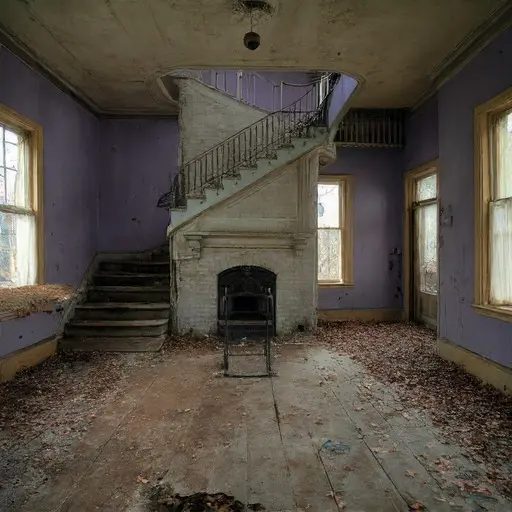
Inside, the home’s quiet elegance continues. Broad hallways connect spacious family rooms where cedar paneling has faded into soft earthy tones. Decorative moldings remain surprisingly intact despite years without care, and curved interior openings mirror the flowing forms established outside. Dust coats every horizontal surface, while vines creeping through cracked window frames remind visitors that the forest has already begun reclaiming its place indoors.
Large windows once welcomed generous daylight into nearly every room, but now their weathered glass filters the overcast light into muted silver tones. The resulting atmosphere feels calm rather than gloomy, highlighting aged wood grain, worn plaster, and subtle imperfections accumulated through generations. Silence fills every room except for the occasional creak of timber responding to changing temperatures.
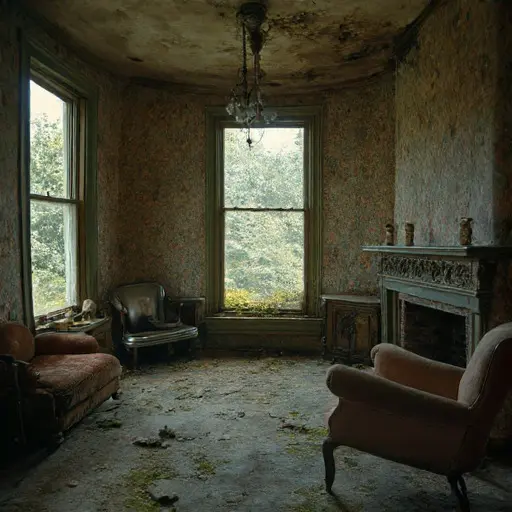
The upper floor reflects the home’s gradual transformation most clearly. Slightly uneven floors and gently sloping ceilings reveal decades of slow structural movement without suggesting imminent collapse. Bedrooms retain fragments of domestic life through faded wallpapers, empty wardrobes, and worn hardwood floors polished by generations of footsteps before finally falling silent.
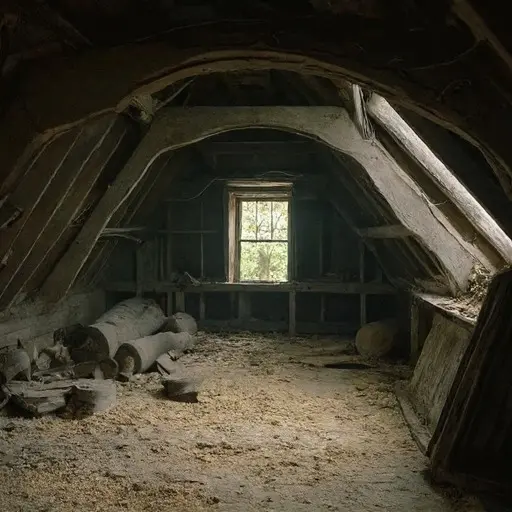
The attic nestles beneath the immense copper roof, where exposed timber framing reveals remarkable craftsmanship. Curved rafters follow the flowing geometry of the gambrel roof above, while tiny dormer windows admit soft grey daylight that illuminates floating dust particles without ever fully brightening the space. Despite missing shingles overhead, the attic remains unexpectedly serene.
Outside once again, the surrounding woodland completes the home’s identity. Mature birches and towering pines nearly conceal the structure from the winding lane, while ferns crowd every edge of the garden. Woodland wildflowers emerge between broken bricks, moss blankets forgotten pathways, and ivy steadily climbs porch columns that still support the weathered roof after all these years.
Today, the abandoned Shingle Style residence survives as an unusually harmonious example of architecture gradually yielding to nature without losing its dignity. The softly rolling roof, lavender-grey shingles, sagging porch, and quiet woodland setting create a scene that feels less like decay and more like peaceful coexistence. Rather than resisting the forest that now surrounds it, the house appears to have accepted its place within it, becoming another enduring feature of the landscape where craftsmanship, memory, and time continue their silent conversation.