The Leaning Gables of the Forgotten Lane
Hidden behind a curtain of tall woodland trees, a Carpenter Gothic Victorian three-story family house stands quietly along a forgotten dirt lane. Built from weathered blue-grey clapboard with crisp white-painted trim, the residence carries the delicate ornamentation and vertical drama of the Gothic revival style while showing the subtle distortions of decades of settling.
The steep black slate roof rises sharply above the structure, creating a dramatic silhouette of exaggerated pointed gables and narrow peaks.
Intricate gingerbread fretwork traces the edges of the porch and roofline, its delicate wooden patterns softened by age but still visible against the faded exterior. A slender corner turret leans slightly above the front veranda, adding to the house’s unusual vertical character.
The façade has developed gentle imperfections over time. The walls bow outward in subtle curves, shutters hang unevenly, and several windows sit at irregular angles within their frames. These changes give the house a quiet sense of movement, as though the structure has slowly adapted to the landscape around it.

The surrounding woodland neighborhood remains calm and overgrown. Tall maple trees create a natural canopy around the property, while moss-covered stone walls follow the edges of neighboring forgotten estates. Winding dirt lanes disappear between the trees, leaving the house isolated despite being part of an old residential landscape.
The front yard has slowly returned to nature. A faded wooden fence with a broken gate marks the boundary of the property, its boards softened and worn by years of exposure. Near the porch steps, an old rusted bicycle rests beneath climbing vines, partially hidden by wild growth that has spread across the garden.
The porch wraps around the front façade in a graceful spiral, its wooden supports showing signs of age while still maintaining the craftsmanship of the original design. The combination of fragile ornament, leaning structures, and natural overgrowth creates a feeling of romantic abandonment rather than complete decay.

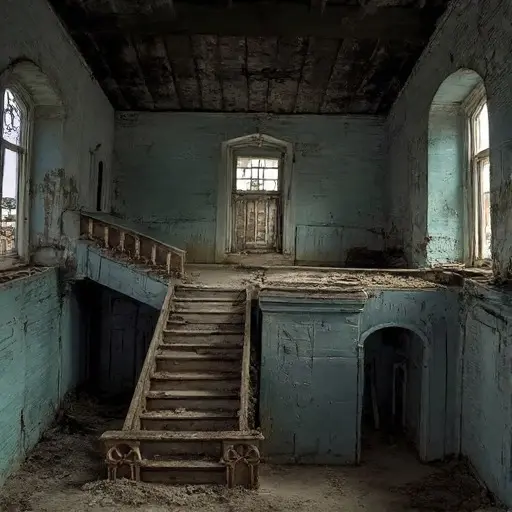
The interiors remain silent and untouched, with no signs of modern life or artificial light. The house stands as a preserved fragment of another era, where handcrafted Gothic details, aging timber, and the surrounding forest have become inseparable parts of the same forgotten story.