The Red Brick House at the Canal Junction
At a quiet abandoned canal junction in a rural delta, a Flemish Revival Victorian family house stands beside still reflective water that mirrors reeds, broken towpaths, and distant windmills. Built from deep red clinker brick interlaced with pale sandstone bands, the structure carries a strong rhythmic geometry that has softened under long exposure to damp air and time.
The stepped gables, once sharply defined, have relaxed into irregular curves.
The façade itself appears subtly leaned, as if the entire building has slowly exhaled and settled into the landscape. Ornate brick corbelling sags in places beneath a weathered copper roof now darkened to a dull bronze tone, further reinforcing the sense of gradual structural fatigue.
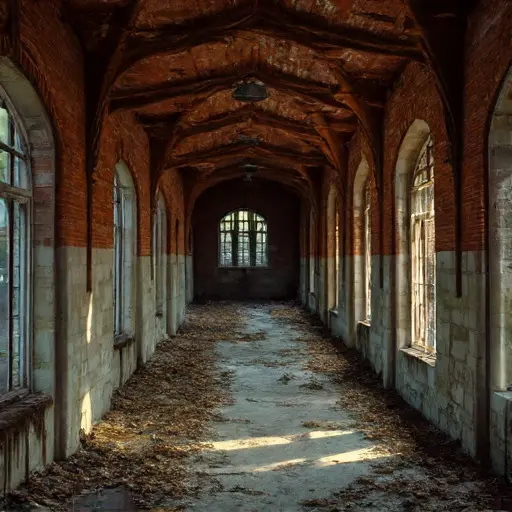
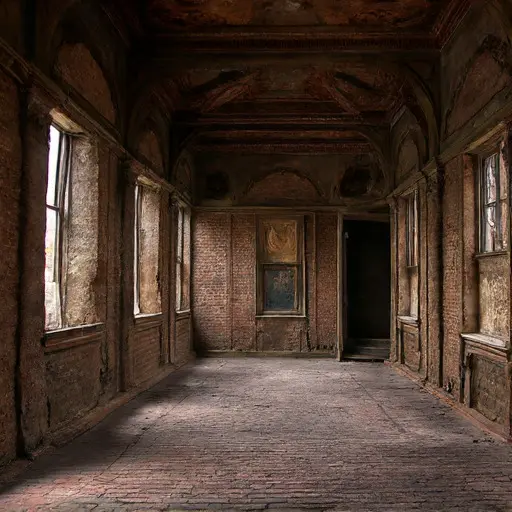
Inside, the house is entirely unlit. No interior illumination exists anywhere within the structure, and every room remains in deep, silent shadow. Soft overcast daylight enters only through tall mullioned windows, carrying faint reflections from the canal water that ripple across brick and sandstone surfaces.
Outside, the yard contains remnants of long-abandoned rural life. A collapsed wooden wheelbarrow rests in overgrown grass, its frame warped and softened by decay. Nearby, a cracked stone mooring post wrapped in ivy marks a forgotten edge of canal access, now nearly indistinguishable from the surrounding vegetation.
The still water of the canal junction stretches outward in quiet symmetry, broken only by reeds and distant windmills on the horizon. The house stands as a softened architectural memory—once precise, now gently surrendered to the slow, damp logic of the delta.