The Mint Ceramic Townhouse of the Forgotten Garden Square
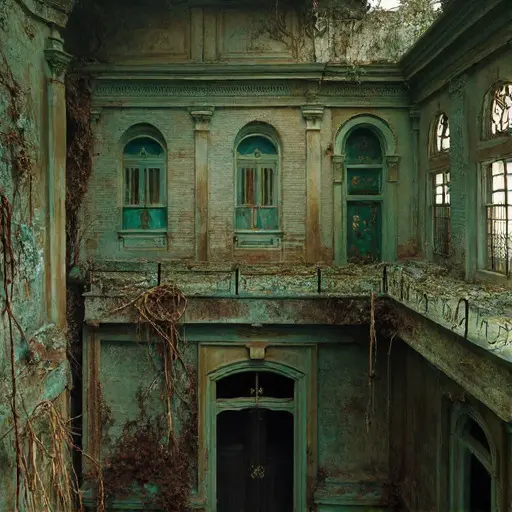
On the outskirts of a forgotten city, an Eastlake Victorian three-story townhouse stands within an abandoned urban garden square. It is constructed from pale mint-green glazed ceramic brick, accented by ivory terracotta detailing and oxidized brass trim that has dulled into a muted, weathered sheen. The façade carries an intricate ornamental logic typical of Eastlake design, now softened by age and environmental reclamation.
The structure is subtly twisted, leaning gently laterally as if the ground beneath it has shifted over time. Unevenly spaced oriel windows project from the façade at irregular intervals, their forms slightly misaligned yet still balanced within the overall composition. Above them, a softly rippled slate roof sags in gentle undulations, reinforcing the sense of long-term settling.
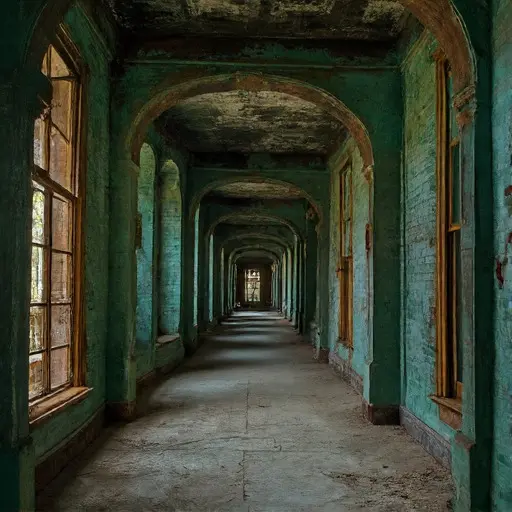
Inside, the townhouse is entirely unlit. No interior illumination exists anywhere within the structure, and every room remains in deep, quiet shadow. Soft overcast daylight filters through broken panes and vine-draped openings, casting faint, fragmented reflections across ceramic brick and brass surfaces.
The surrounding garden square is fractured and overgrown. Cracked cobblestones form broken geometric patterns beneath the canopy of linden trees, which bend and lean over the architecture as if drawn toward it over time.
In the courtyard, a weathered stone labyrinth lies partially broken, its once-intended paths now disrupted by vegetation and collapse. Nearby, a wrought-iron pergola has fallen inward, its structure overtaken by climbing vines that weave through its collapsed geometry.
The townhouse stands as a quiet urban relic—ornate, asymmetrical, and slowly absorbed into the forgotten green geometry of the abandoned square.