The Whitewashed House at the Canyon Rim
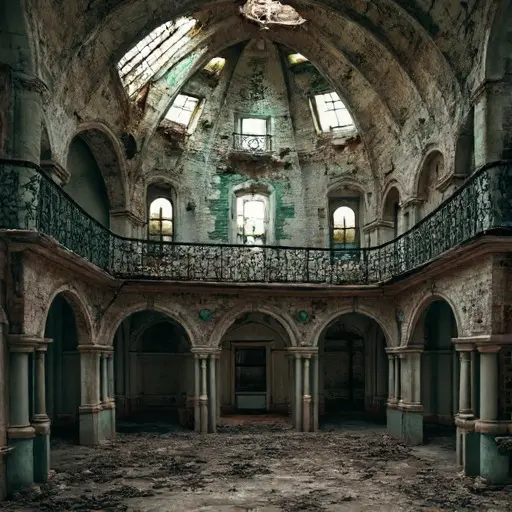
On a vast desert plateau near the edge of a canyon rim, an eclectic Victorian three-story house stands exposed against pale stone ground and sparse, resilient shrubs. Built from whitewashed brick, the structure is accented with ornate black cast-iron balconies and emerald glazed tile inlays that catch faint ambient light even in its state of abandonment.
The house’s form has subtly warped over time.
A gently sagging central roof—domed in suggestion rather than strict geometry—presses downward into uneven bay projections that shift the silhouette into something slightly unbalanced but still recognizably grand.
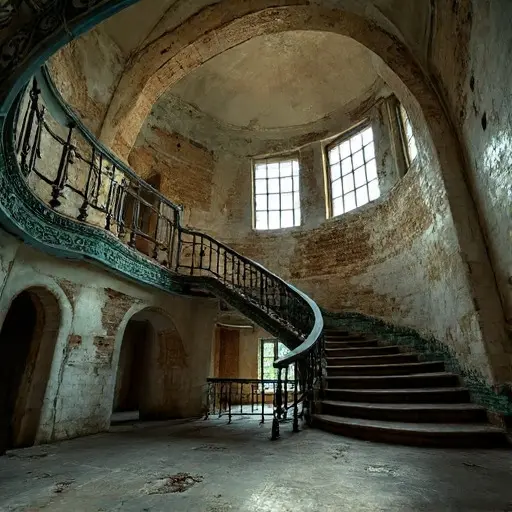
Inside, the structure is entirely unlit. No windows emit any glow, and all rooms remain dark, with only soft overcast daylight filtering through broken glass and open frames. The cast-iron balconies cast intricate, fragmented shadows across the interior void.
Adjacent to the house, a collapsed glass conservatory lies scattered across the desert ground. Fractured panes of glass spill outward like shattered water, reflecting the pale sky and emphasizing the fragility of the once-contained structure.
A rusted hand water pump stands half-buried in sand nearby, its metal body worn by exposure and time. Together with the conservatory ruins, it suggests a former attempt to sustain life in an environment that has since reclaimed everything.
The house remains isolated and quiet at the canyon rim—an architectural memory suspended between ornate craftsmanship and the slow erosion of desert time.