The Ribboned Tower House of the Reclaiming Lakeshore Marsh
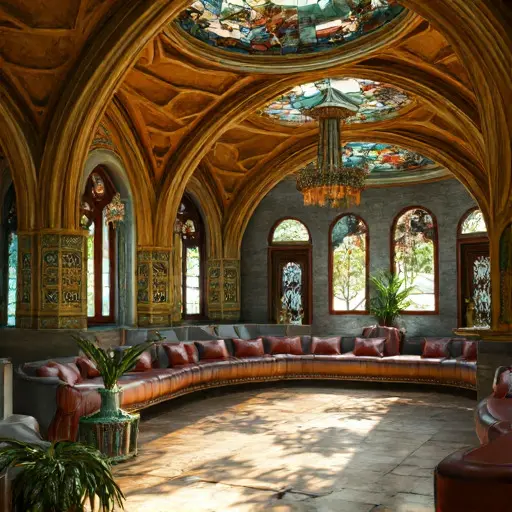
Along the edge of an abandoned lakeside marsh, where reeds sway through shallow water and young birch trees rise from reclaimed soil, stands a Victorian Stick Style residence transformed into a vividly organic architectural organism. Once a composition of rigid vertical framing and decorative stickwork, the structure now flows outward in interconnected rounded volumes, eliminating flat façades entirely. Its surface is clad in alternating bands of saffron-yellow glazed terracotta, deep turquoise stone, blush-pink limestone, and matte aubergine brick, producing a layered chromatic rhythm that shifts as light moves across the marsh.
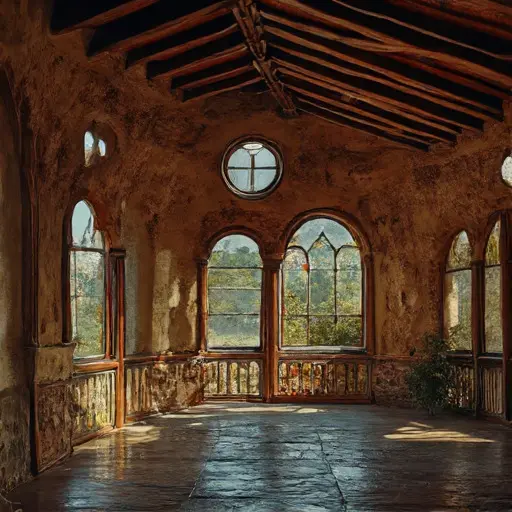
The architecture expands in soft, breathing forms. An enormous off-center octagonal tower rises above the composition, its volume ballooning gently rather than asserting vertical dominance. Above it, a sweeping roof of emerald and cobalt ceramic scales ripples in layered waves, each segment catching muted daylight differently as clouds pass overhead. Thick chimneys curve in slow, elegant arcs, while decorative timber brackets twist into fluid structural gestures that blur the boundary between ornament and support. The stained-glass windows—rounded diamonds and curved hexagons—are scattered asymmetrically across the façade, reinforcing the sense of spontaneous organic growth.
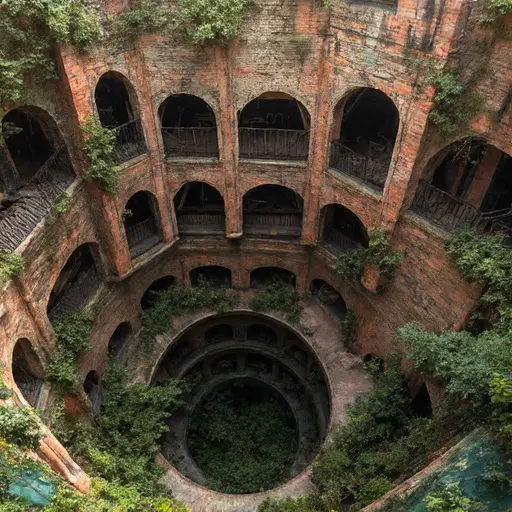
Outside, the abandoned lakeside marsh steadily reclaims the estate. Tall reeds press against the looping verandas, while flowering water plants spread across shallow pools that mirror fragments of the colorful façade. A weathered wooden rowboat lies overturned beside a rusted Victorian pram, both slowly sinking into dense wild grasses. Young birch trees grow through gaps in the porch structure, their pale trunks threading through spindlework like natural reinforcements. The residence endures as a continuous negotiation between architecture and wetland ecology, where color, curvature, and vegetation merge into a single evolving landscape.