The Ribboned Glass House Along the Quiet Riverbank
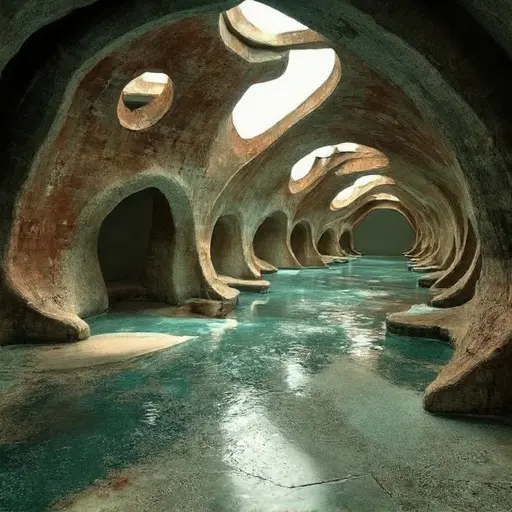
The Victorian riverside residence stands along an abandoned riverbank meadow where reeds and wild grasses weave through cracked stone embankments. Its form is entirely biomorphic, as if shaped by slow fluid motion rather than construction, composed of flowing bands of sapphire glass, burnt sienna sandstone, and pale moss-green glazed brick that merge seamlessly without clear boundary. The structure bulges outward in irregular lobes, each volume swelling and contracting like a frozen tide.
There is no stable symmetry; instead, the building reads as a continuous geological-organic hybrid, embedded into the landscape rather than placed upon it.
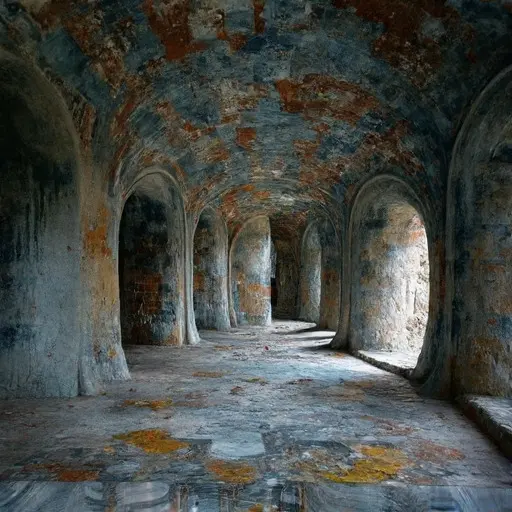
Above, the roof twists into overlapping ribbon-like planes of oxidized bronze and deep indigo ceramic, folding and intersecting in uneven arcs that suggest motion frozen mid-curl. These planes do not align to a single axis but instead drift in layered directions, allowing soft daylight to filter through narrow gaps and spill into interior spaces in shifting fragments. The material patina varies across the surface, with bronze oxidation deepening in sheltered folds while ceramic sections retain cooler tonal stability, reinforcing the impression of environmental interaction over time.
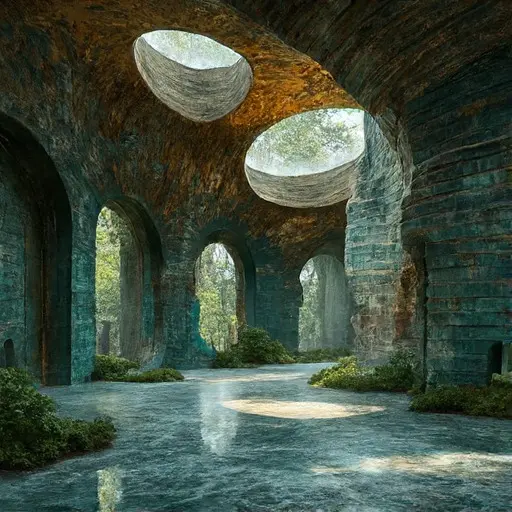
Outside, the riverbank continues its slow reclamation. A rusted iron observation wheel fragment lies half-submerged in vegetation near a collapsed mosaic fountain that still spills shallow reflective water into cracked stone channels. The residence and landscape merge visually at their edges, where reeds press into the building’s lower lobes and water reflections climb the glass surfaces. The entire scene behaves like a single continuous organism—architecture, ruin, and river bound together in a quiet, irreversible flow.