The Cobalt Mosaic House of the Silent Canal Basin
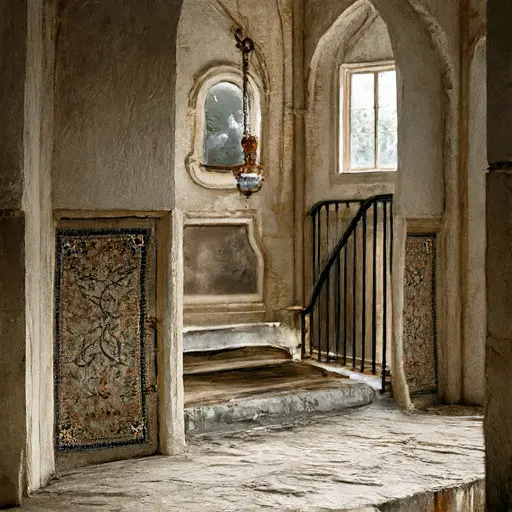
The Byzantine-Moorish Victorian residence sits along a forgotten canal basin where cracked stone quays descend into still reflective water edged by wild reeds. Constructed from soft ivory limestone interlaced with deep cobalt and bronze mosaic bands, the three-story structure presents a gently undulating façade that seems to breathe across its width. The center of the building curves inward slightly, while the corners bulge outward in restrained asymmetry, giving the impression of a structure shaped as much by settling time as by architectural intent.
Arched windows of varying proportions are embedded within carved stone frames whose decorative patterns have softened under long exposure to moisture and wind, dissolving crisp geometry into muted ornament.
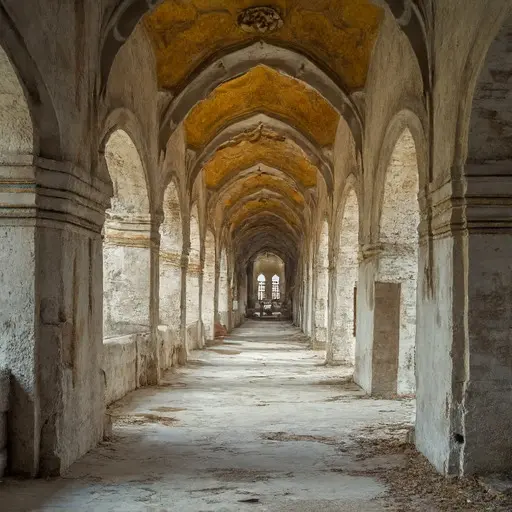
Above, the roof is composed of layered oxidized copper domes and flat slate terraces, arranged in a deliberately irregular composition that appears to have shifted slightly over time. The domes vary in scale and alignment, their patinated surfaces blending green and muted brown tones that contrast with the pale stone below. Between these forms, slate terraces step unevenly, collecting moisture and debris from the surrounding air. The entire roofscape reads as a slow architectural accretion rather than a fixed design, as if each element was added in response to changing environmental pressures rather than a single moment of construction.
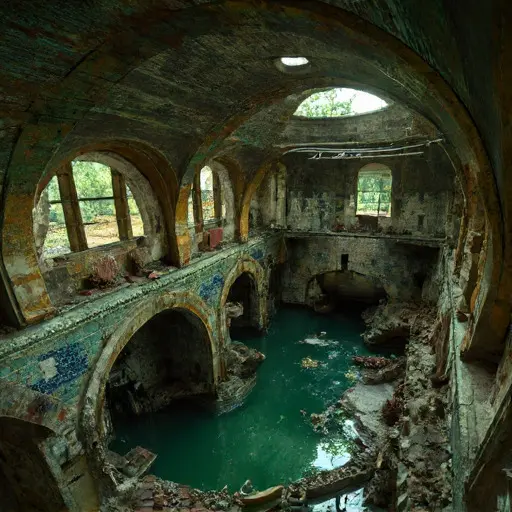
The surrounding canal basin is quiet and enclosed, its cracked stone quays slowly giving way to encroaching vegetation. A rusted iron mooring post stands at an angle near a collapsed wooden rowing boat that is now partially submerged in reeds and shallow water. The reflections on the canal surface remain undisturbed, mirroring the softened symmetry of the residence. Together, architecture and environment form a single continuous composition of erosion, color, and stillness, where mosaic, stone, copper, and water dissolve into one another under the steady pressure of time.