The Celadon Marble House Above the Reclaiming Garden
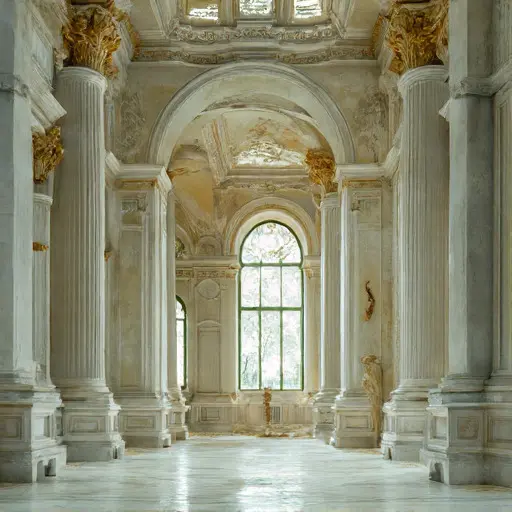
The Baroque Revival Victorian mansion was conceived as a formal hillside residence overlooking a meticulously terraced garden system. Built from soft pearl-white stucco and pale celadon marble, the three-story structure was designed to reinterpret classical European grandeur through a lens of controlled asymmetry and softened ornamentation. Its façade gently ripples across its width, as though the entire building had been subtly shaped by slow geological movement rather than rigid architectural planning.
Tall arched windows of varying proportions punctuate the elevation, each framed by carved stone surrounds that differ slightly in scale, reinforcing the impression of organic variation within an otherwise formal composition. Above, a complex roofscape of dull silver lead and faded jade copper forms broken pediments and asymmetrical domes that lean just off-axis, giving the structure a quiet sense of imbalance held in equilibrium.
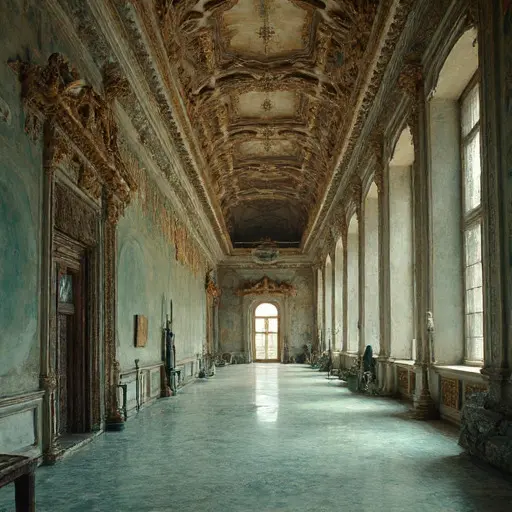
As the formal garden declined, the mansion’s relationship with its landscape began to shift. The terraced hillside once carefully maintained through layered stone retaining walls and trimmed hedges gradually gave way to uncontrolled vegetation. Cracked marble stairways became partially obscured by wild ivy, and balustrades along the terraces began to fracture under root pressure and seasonal freeze cycles. The rusted wrought-iron gazebo near the lower garden level collapsed unevenly, its skeletal frame folding inward as vines overtook its structure. The moss-covered stone fountain, once a central focal point of the garden, filled slowly with still water and drifting leaves as drainage systems failed and maintenance ceased entirely.
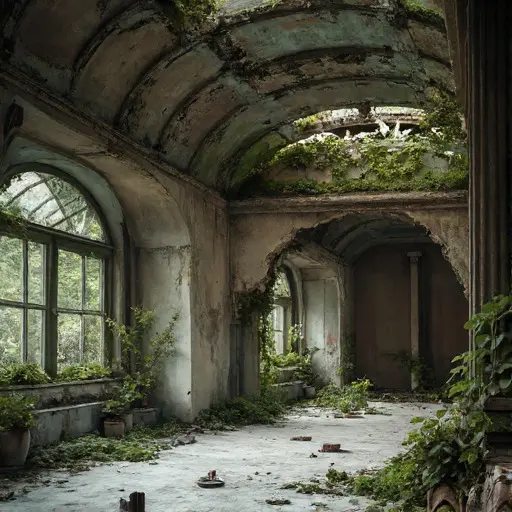
Today, the Baroque Revival Victorian mansion remains embedded within the reclaimed terraced hillside garden. The once-formal composition has been softened by decades of vegetation growth, erosion, and structural settling. The cracked marble stairways still trace their original geometry beneath layers of moss and ivy, while the collapsed gazebo and silent fountain stand as remnants of the garden’s former order. The mansion itself endures as a slowly dissolving expression of controlled grandeur—its rippling façade, off-axis domes, and weathered materials continuing to blur the boundary between architectural intention and natural reclamation.