The Greyhaven Romanesque Mansion Left to Forest Encroachment
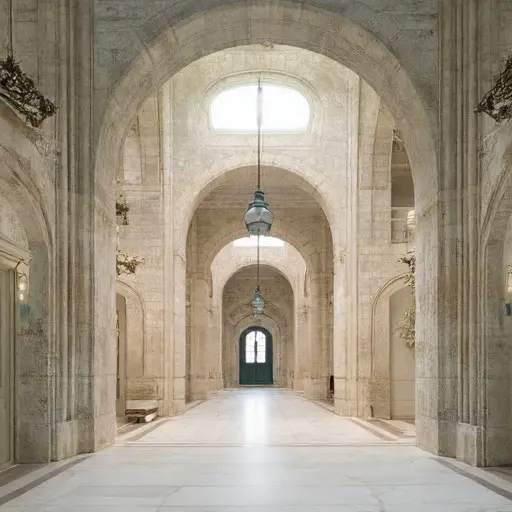
The Greyhaven Mansion was constructed in the late nineteenth century for a landholding family whose influence derived from quarry operations and regional infrastructure development. Designed in the Romanesque Revival style, the estate prioritized solidity and permanence through its heavy arches, thick buttressed walls, and squat square towers capped with conical slate roofs. The household consisted of multiple generations of the family alongside a small staff responsible for maintaining both the massive stone architecture and the surrounding formal landscape.
Daily life centered on estate governance, resource management, and seasonal oversight of woodland and agricultural holdings. The mansion functioned as both residence and administrative center, projecting stability and authority within a remote forest setting.
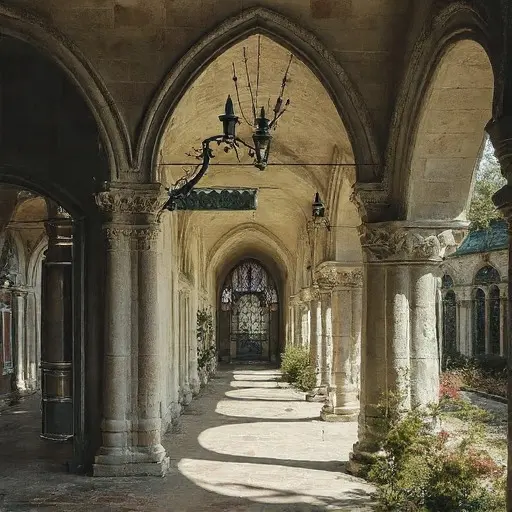
By the late 1920s, the Greyhaven household began to experience financial strain due to declining quarry output and increased maintenance costs associated with the mansion’s massive Romanesque construction. The thick stone walls, arcaded loggias, and buttressed towers required constant upkeep to prevent moisture penetration and structural fatigue. As revenues decreased, repairs were delayed and sections of the estate were closed to reduce operational costs. Entire wings of the mansion saw reduced occupancy, while heating was limited to essential rooms only. Formal gardens of white marble terraces, crimson rose hedgerows, and violet foxglove clusters began to lose their strict geometric maintenance as staffing levels declined. Administrative records show increasing gaps in maintenance logs, signaling a gradual transition from fully occupied estate to partially maintained structure at the forest edge.
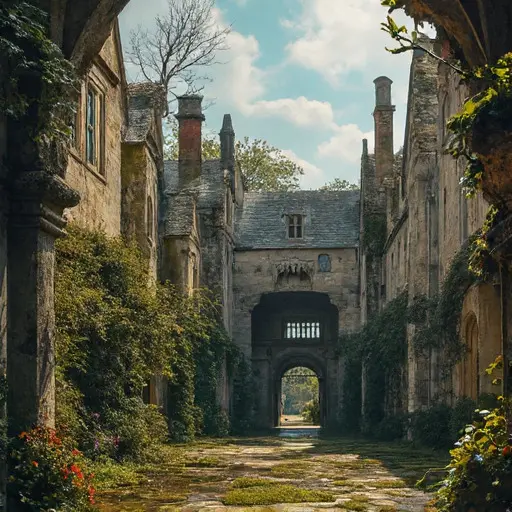
By the early 1940s, after prolonged financial decline and the dispersal of its remaining occupants, the Greyhaven Mansion was fully abandoned. No restoration or redevelopment efforts were undertaken, as the scale of structural mass and ownership uncertainty made intervention impractical. The estate remained standing deep within the forest, slowly weathering under seasonal conditions and accelerating vegetation growth. Interior spaces were left in their final state of occupation, gradually transforming as moisture, moss, and structural fatigue reshaped the Romanesque Revival fabric. The mansion persists as an unresolved architectural ruin, neither preserved nor repurposed, with its grounded stone silhouette quietly dissolving into the surrounding woodland.