The Hollowbrook Queen Anne House Left to Forest Reclamation
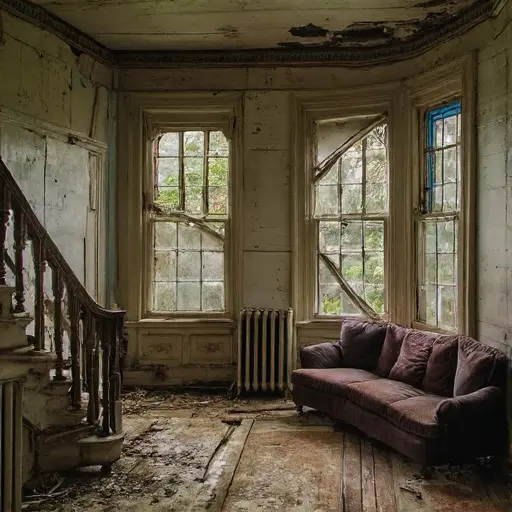
The Hollowbrook Queen Anne house was built in the late nineteenth century as a family residence for a regional surveyor and his household, positioned deep within a forest hollow chosen for its isolation and proximity to timber routes. The structure was designed with typical Queen Anne complexity—turrets, gables, and ornamental wraparound porches—intended to reflect both prosperity and architectural ambition. The household consisted of parents and three children, with occasional domestic assistance during peak surveying seasons.
Early life in the home was orderly, with the wraparound porch serving as a social and observational space overlooking the surrounding forest. Despite its intricate design, the house remained functional for decades, supported by steady employment and modest local trade.
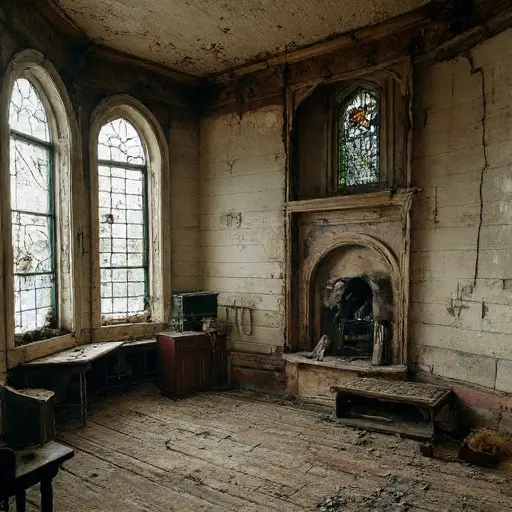
By the late 1920s, the Hollowbrook household began to experience financial decline following reduced regional demand for surveying services and rising maintenance costs associated with the increasingly unstable structure. The intricate Queen Anne detailing required constant upkeep, but repairs became sporadic as resources diminished. Portions of the wraparound porch were closed off after sections collapsed, and the remaining structure was reinforced only minimally. Ivy and forest vegetation began to infiltrate exterior walls, accelerating decay in weakened timber areas. Interior heating became unreliable, and entire rooms were abandoned seasonally to conserve resources. Over time, the house transitioned from a fully occupied residence into a partially inhabited structure marked by uneven maintenance and growing structural neglect.
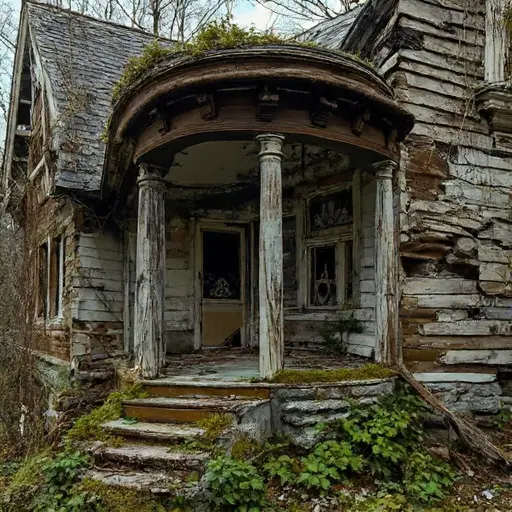
By the early 1940s, after prolonged abandonment and the dispersal of its remaining occupants, the Hollowbrook Queen Anne house was fully deserted. No restoration or preservation efforts were undertaken, as the extent of structural damage and legal ambiguity surrounding ownership prevented intervention. The house remained deep within the forest hollow, slowly consumed by vegetation and weather. Interior spaces were left in their final state of occupation, gradually collapsing under the weight of time, moisture, and unchecked biological growth. The structure persists as an unresolved ruin, neither restored nor repurposed, its ornate Queen Anne form dissolving into the surrounding forest in quiet, continuous decay.