Abandoned Victorian Swiss Chalet house on a wooded hillside slope
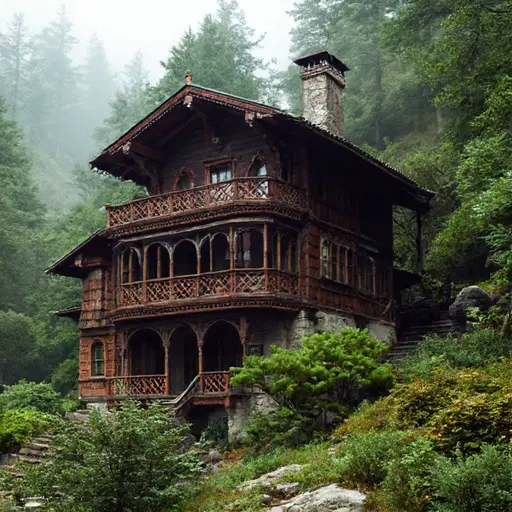
A Victorian Swiss Chalet-style house is shown from an oblique front-left angle, positioned on a gently rising wooded incline where the terrain steps downward in moss-covered layers and exposed tree roots. The structure is dominated by a vast, deeply overhanging roof whose extended eaves project far beyond the walls, forming a continuous protective canopy over the entire composition. The roof is covered in weathered wooden shingles that transition from sun-bleached gray to muted brown and charcoal tones, with accumulated debris gathering along the lower edges.
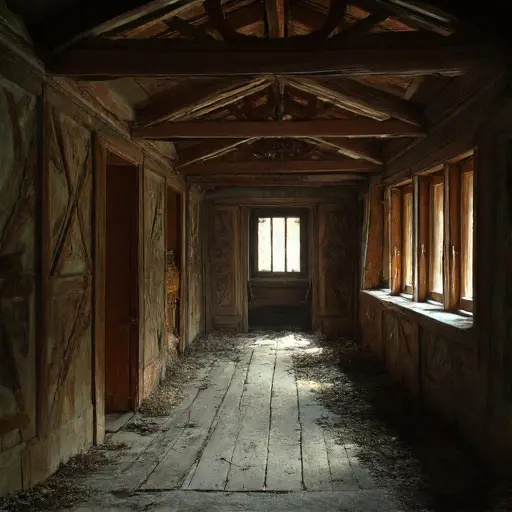
The house is primarily timber-framed, with horizontal plank siding reinforced by decorative diagonal braces that create repeating geometric patterns across the façade. The wood surface shows uneven aging—pale silver where exposed to wind and light, and deeper umber tones in sheltered recesses.
Carved balcony brackets project at regular intervals beneath the eaves, their scrollwork still visible but softened by erosion and time.
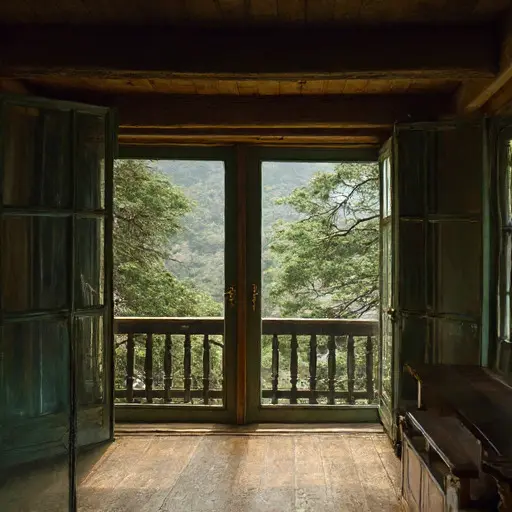
A wide, multi-level veranda wraps around the front and left sides of the building, supported by thick square posts that subtly taper upward. The railing consists of intricate wooden lattice panels, many of which have loosened or bowed slightly due to long-term exposure. Tall French windows open onto the veranda, framed in faded forest-green paint that has shifted toward muted sage, with glass panes reflecting fragmented images of surrounding trees.
The roofline includes small dormer windows set deeply into the slope, each framed with carved wooden detailing that echoes the triangular and diamond motifs of the façade. A central front gable displays a softened timber sunburst pattern, still readable despite weathering. Two tall stone chimneys rise at opposite ends of the structure, their surfaces mottled with lichen and blending visually into the wooded surroundings.
The house was abandoned gradually after the decline of a small mountain logging operation that once sustained the region. As work shifted away from the valley, the property became increasingly difficult to maintain due to its hillside position and exposure to heavy seasonal weather. Occupancy reduced over several years until the building was left unheated and unattended, allowing moisture and vegetation to slowly take hold of the structure without sudden collapse or dramatic departure.
The surrounding landscape has begun to reclaim the approach. A winding gravel path is partially obscured by roots and grass. Fern clusters and wild blueberry shrubs grow close to the veranda steps. A collapsed wooden bench remains beneath a leaning tree at the edge of the clearing, marking the final point of human presence before the forest edge resumes control of the terrain.