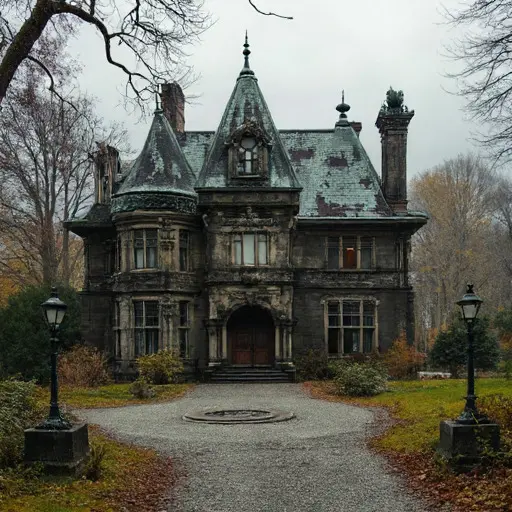
The abandoned Romanesque house and the forecourt that stopped keeping time
The house was built during a period when civic architecture and private ambition briefly shared the same language. Commissioned in 1887 by a railway financier known for his insistence on permanence, the residence was intended to feel less like a home and more like a private monument. Richardsonian Romanesque was chosen deliberately—its weight, its heaviness, its refusal to appear temporary.
From the beginning, locals described it as “settled,” as if the building had already decided where it belonged. The rusticated granite was quarried from a nearby ridge, and even during construction it appeared as though the structure was being uncovered rather than assembled.
When completed, it became a fixed point in the landscape, visible across open fields and slowly growing woodland alike.
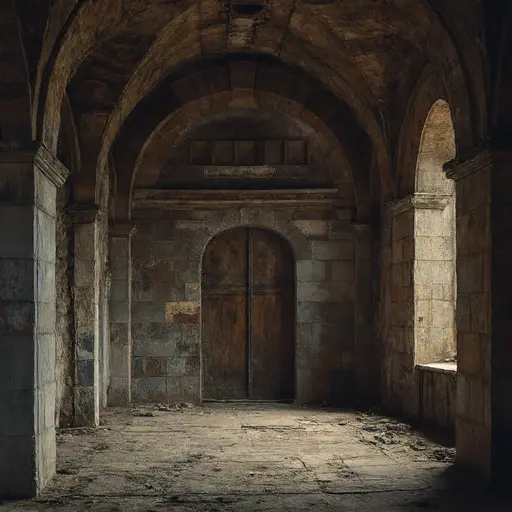
The abandonment began after the decline of the railway fortunes that had sustained the household. At first, it was financial restructuring—staff reductions, reduced heating, limited seasonal occupancy. The house was too substantial to maintain casually, yet too symbolically important to abandon outright. For several years, it existed in partial use: occasionally opened, briefly inhabited, then sealed again.
The final departure occurred in winter, though no formal record marks the exact day. What is known is that by the following spring, no smoke rose from the copper-capped chimney, and the lanterns near the entrance remained unlit. There was no sale, no demolition proposal, only silence and the gradual assumption that the building had become inactive rather than abandoned.
Without upkeep, the structure did not deteriorate quickly. Its materials resisted rapid decay. Instead, time expressed itself in subtle shifts: copper deepened into darker green, stone joints collected windblown soil, and the small asymmetries in the upper clustered windows became more noticeable as surrounding vegetation grew unevenly in response to light and shelter.
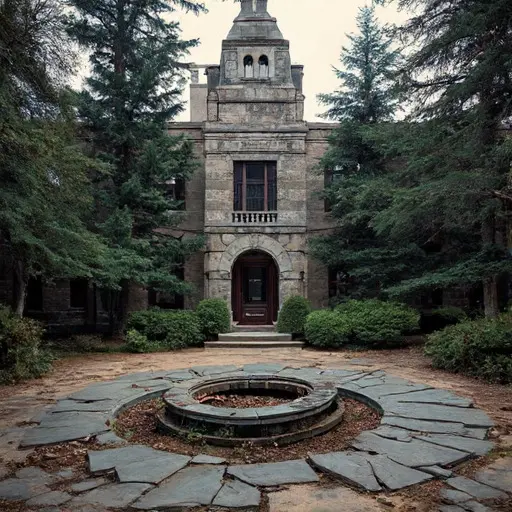
The forecourt, once a carefully controlled approach, lost its sense of intention first. Gravel dispersed beyond its borders. Drainage channels filled partially with sediment. The circular flagstone pattern began to break visually as moss and grass established themselves in seams too narrow to clear. The sundial base remained, but its purpose became unreadable.
The house itself, however, remained dominant. Even in abandonment, it did not yield visually to the landscape. Instead, it appeared to hold the terrain in place, as though the earth had settled around it rather than the other way around.