Where the Coastal Wind Still Reads Blackthorne Hall
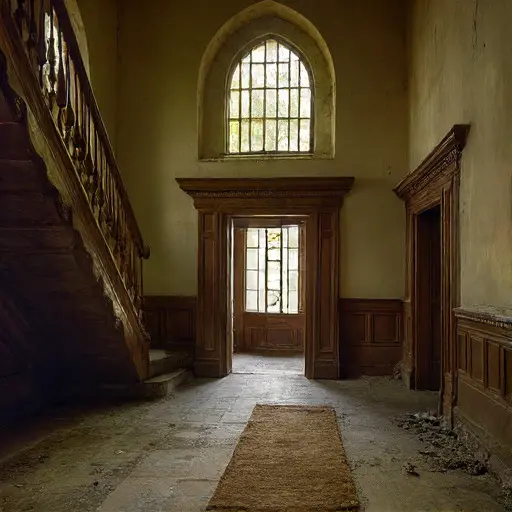
Blackthorne Hall was completed in 1887 for the Carradine family, who established the estate at the edge of a coastal plateau where trade winds shaped both agriculture and daily life. The house was conceived as a statement of permanence against a landscape that otherwise refused stillness, its Gothic Revival silhouette intended to assert order through verticality and disciplined stonework. For several decades it functioned as both residence and seasonal administrative base for landholdings extending inland, with the carriage house and glasshouse supporting a modest but productive agricultural operation.
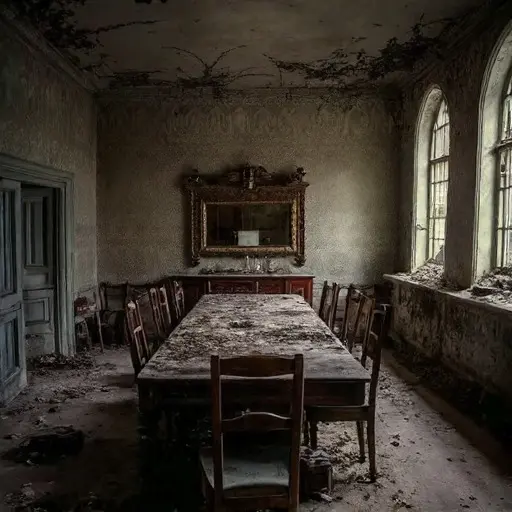
The decline of Blackthorne Hall began subtly in the early 1910s when coastal shipping routes shifted and the Carradine agricultural exports lost their primary markets. Maintenance budgets were reduced incrementally, affecting first the ornamental elements—window repainting, roof ridge upkeep, and carriage path stabilization—before extending to structural repairs. By the 1920s, portions of the estate were no longer in regular use. The glasshouse became seasonally abandoned after repeated pane failures, and the carriage house was left partially unused, its doors often left ajar as activity diminished. The surrounding fields began to revert naturally, with grasses overtaking former boundaries and drainage lines softening into indistinct depressions.
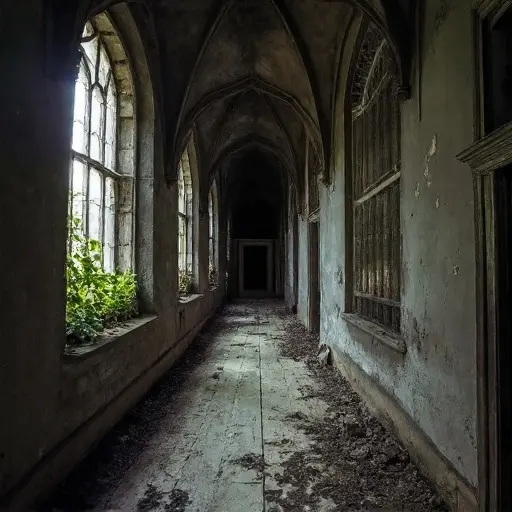
By the late 1930s, inheritance disputes and mounting restoration costs prevented any unified ownership from maintaining Blackthorne Hall. The estate was effectively left in legal suspension, with no sustained occupancy recorded afterward. Weathering intensified across exposed rooflines, copper cresting dulled into a continuous green patina, and internal spaces began to deteriorate in parallel with the external landscape’s reclamation. The house was never formally restored or reoccupied, and no definitive closure followed its abandonment. It remains standing above the coastal grasses, partially defined yet steadily dissolving into the same wind-driven environment that once shaped its placement, holding its Gothic form without resolution or return.