The Hollowspire Circular Library Manor Left to Overgrowth
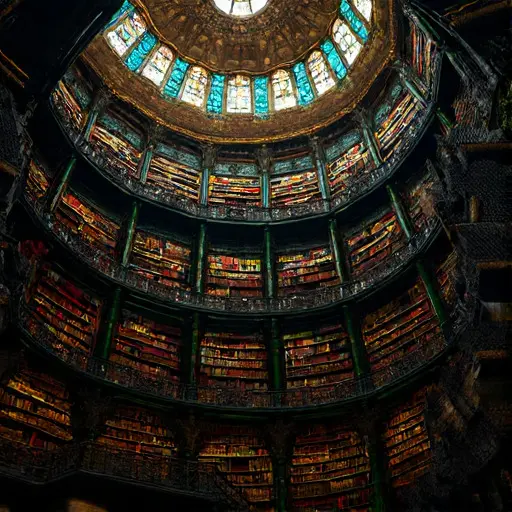
The Hollowspire Manor was commissioned in the late nineteenth century by an eccentric patron of architecture and natural philosophy who sought to unify knowledge, domestic life, and botanical cultivation within a single continuous structure. Built on a secluded estate at the edge of a wooded valley, the house became home to a large extended household of scholars, attendants, and family members. At its core stood the circular library tower, serving as both intellectual engine and symbolic heart of the residence, around which the hexagonal salons and conservatories were arranged like orbiting compartments of study and leisure.
Early life within the manor was intensely structured, revolving around cataloging, botanical research, and curated social gatherings beneath the stained-glass glow that defined its interior atmosphere.
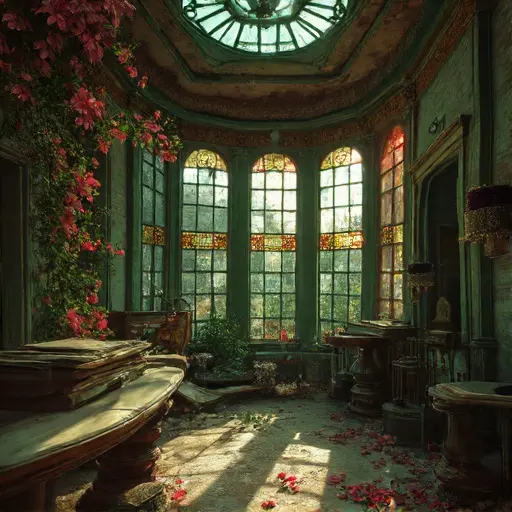
By the late 1920s, the Hollowspire household began to experience financial strain following the decline of its patron’s estate holdings and reduced institutional funding for large-scale private research residences. Maintenance of the manor’s highly complex systems—its interlocking terraces, stained glass assemblies, and botanical conservatories—became increasingly unsustainable. Sections of upper arcaded walkways were closed for safety, and portions of the library tower were left unheated to conserve resources. The once-active research community within the house gradually dispersed, leaving behind incomplete catalogues, abandoned experiments, and correspondence that went unanswered. Over time, the structure shifted from a living intellectual organism into a fragmented shell of its former operational rhythm.
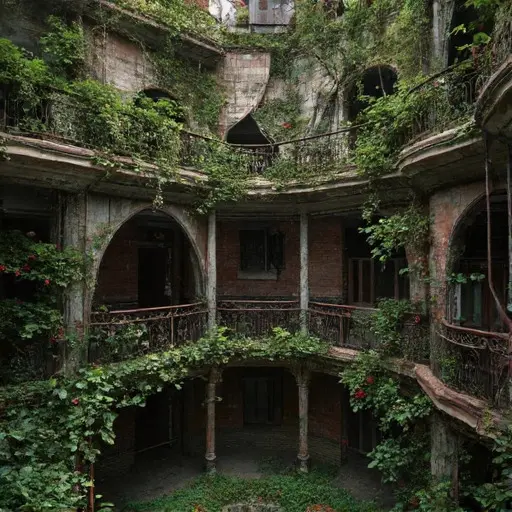
By the early 1940s, after prolonged financial collapse and the dispersal of its remaining occupants, the Hollowspire Manor was fully abandoned. No restoration or preservation efforts were undertaken due to the immense complexity of its interlocking structure and the absence of clear ownership succession. The estate remained sealed by time and vegetation, slowly transforming under seasonal weathering and unchecked botanical growth. Interior spaces were left exactly as they were in the final years of occupation, allowing dust, moisture, and plant life to gradually overwrite the architectural precision that once defined it. The manor persists as an unresolved Victorian artifact of extraordinary scale, neither reclaimed nor restored, with its circular library tower still standing as a silent monument to intellectual ambition and gradual disappearance.