The Ellingford Canal Second Empire Townhouse Left in Reflection Stillness
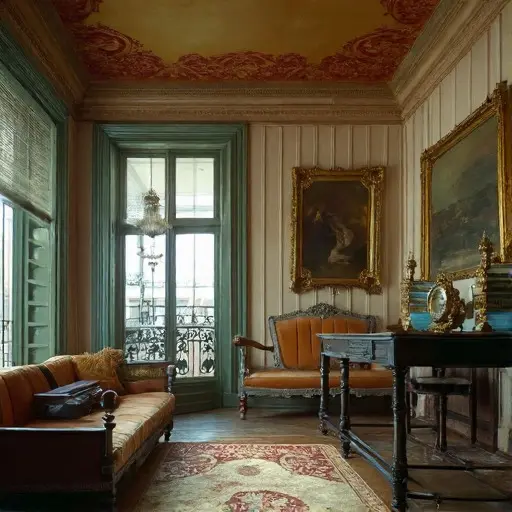
The Ellingford Townhouse was constructed in the late nineteenth century along a narrow canal corridor during a period of active urban water transport and small-scale commercial shipping. Designed in the Second Empire style, the residence emphasized vertical organization and balanced symmetry, with its mansard roof and central entrance bay reflecting both status and functional urban efficiency. The household consisted of two generations supported by a small staff responsible for maintaining both the interior and the linear waterside terrace.
Daily life was closely tied to canal activity, with goods movement, correspondence, and municipal scheduling shaping the household’s rhythm. The terrace served as an extension of domestic space, integrating water reflection and architectural order into everyday living.
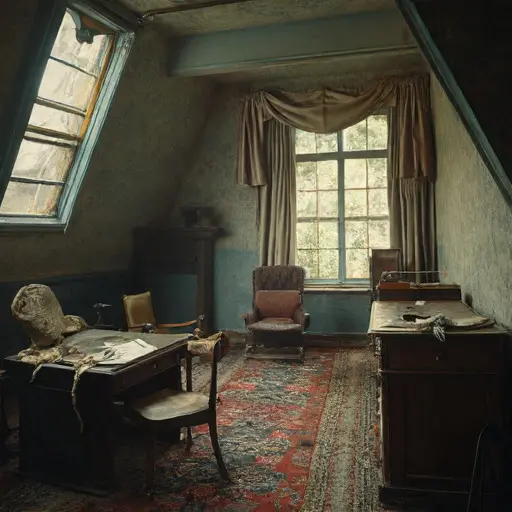
By the late 1920s, the Ellingford estate began to experience financial strain as canal-based trade declined and larger transportation systems redirected commerce away from smaller waterways. Maintaining the sandstone plaster façade, glazed terracotta banding, and wrought iron balconies became increasingly difficult under constant exposure to moisture and seasonal flooding. Portions of the house were used less frequently to conserve heating and maintenance resources, and the waterside terrace began to lose its strict planting order. Geraniums and ivy continued to grow in the planters, but without consistent trimming they spread irregularly across the stone edges. Correspondence regarding trade accounts and property maintenance accumulated without consistent response, reflecting a slow reduction in administrative control.
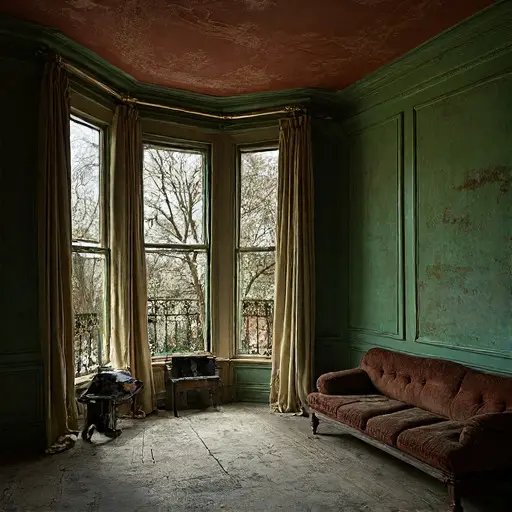
By the early 1940s, following prolonged economic decline and unresolved inheritance disputes, the Ellingford Townhouse was fully abandoned. No restoration efforts were undertaken, and ownership complications prevented any coordinated intervention. The structure remained beside the canal but deteriorated slowly under humidity, flooding, and lack of maintenance. Interior spaces were left in their final state of use, preserving furnishings, documents, and domestic arrangements beneath layers of dust and waterborne air. The townhouse endures as an unoccupied Second Empire residence, quietly mirrored in the canal beside it, gradually fading without return, renewal, or resolution.