The Willowbrook Stick-Eastlake Mansion Left in Garden Quiet
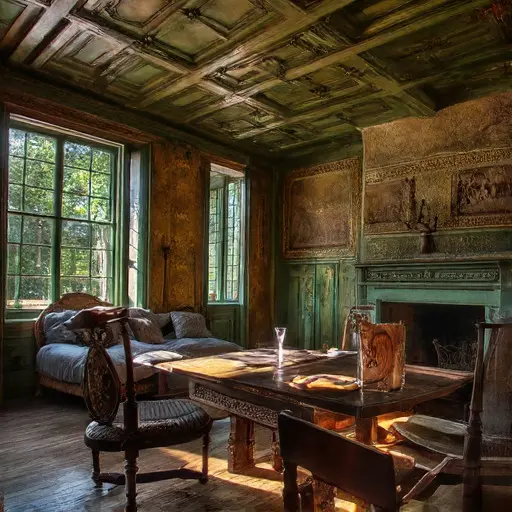
The Willowbrook Mansion was built in the late nineteenth century by a family of skilled builders and decorative artisans who settled on a forest-edge property to combine residence with workshop and garden estate. Designed in the Stick-Eastlake style, the house emphasized visible structure, ornamental woodworking, and expressive color, reflecting both technical craftsmanship and domestic pride. The household consisted of parents and two children, supported by a small group of apprentice carpenters and gardeners who helped maintain both the residence and its elaborate grounds.
Daily life revolved around shared work, artistic production, and careful maintenance of the gardens, with evenings spent in the parlor reviewing designs, correspondence, and household accounts. For many years, the estate functioned as both home and living workshop, sustained by steady commissions and local patronage.
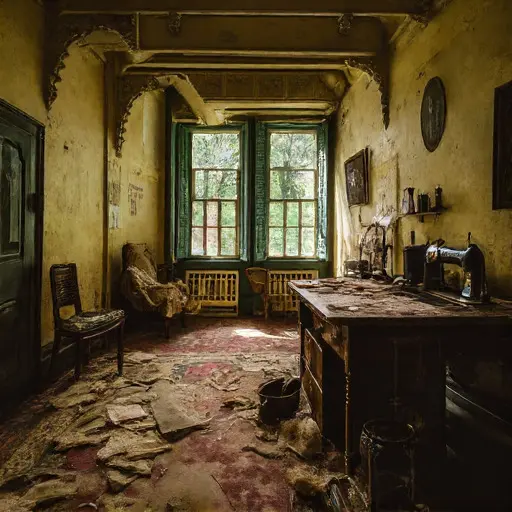
By the late 1920s, the Willowbrook estate began to experience financial strain as craft commissions declined and local demand for decorative woodworking weakened. Maintaining the highly detailed Stick-Eastlake structure proved increasingly expensive, requiring constant care of exposed timber, ornate brackets, and layered roofing. Staff were gradually reduced, and sections of the house were closed off to conserve heating and resources. The gardens, once carefully curated, began to grow unevenly as maintenance schedules were interrupted. Correspondence accumulated on desks without response, and unfinished projects were left in place as attention shifted away from creative production toward financial survival. Moisture and seasonal weathering slowly affected the exterior finishes, softening the crisp contrast between cobalt beams, porcelain cladding, and ruby shingles.
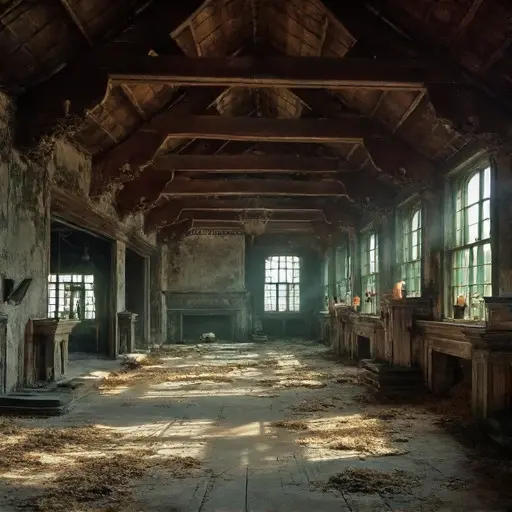
By the early 1940s, following prolonged financial collapse and fragmented inheritance disputes, the Willowbrook Mansion was fully abandoned. No restoration efforts were undertaken, and ownership complications prevented any coordinated intervention or redevelopment. The structure remained standing within its overgrown gardens but gradually deteriorated under seasonal exposure and unchecked vegetation. Interior spaces were left in their final state of use, preserving tools, textiles, and correspondence beneath accumulating dust. Over time, the once vibrant artisan home became a silent relic of craft and domestic life, slowly dissolving into the surrounding landscape without return or renewal.