The Mansion That Held Its Days in a Perfect Spiral
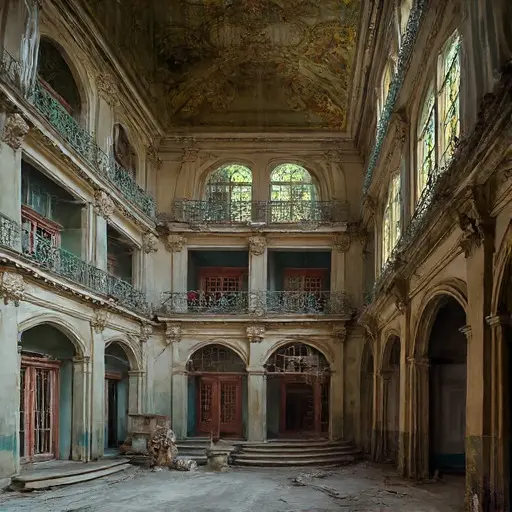
The mansion stands with the confidence of something built to organize life rather than simply contain it. Even in abandonment, its geometry feels active—like a system that still expects movement through its corridors and courtyards. The mansard roof rises in disciplined rhythm, its slate patterning still legible as a kind of architectural language.
It belonged to the Delaroche household, remembered not for grand events but for the structure of their days. Mornings began in the orchard. Afternoons drifted through the pergola. Evenings tended to gather near the reflecting pool, where conversation would settle into long, unbroken stretches. The house did not host time—it arranged it.
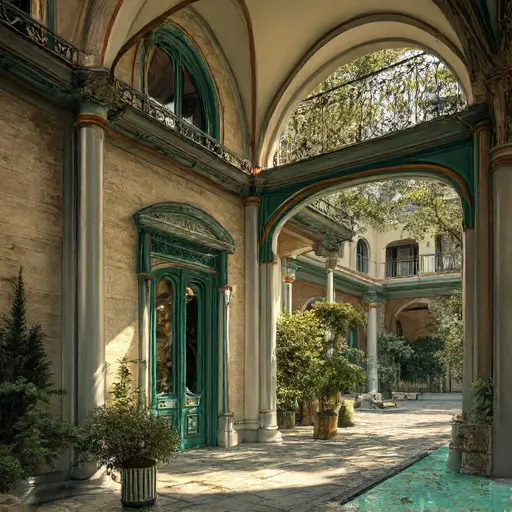
The courtyard feels like the center of a slowly unwinding spiral. The circular reflecting pool, lined in turquoise mosaic, holds still water that mirrors not the sky but the idea of gathering. Pink camellias, golden marigolds, and white lilies grow in layered density around its edge, arranged with a precision that suggests habit rather than design.
The cobalt pergola bends under the weight of grapes, their clusters spilling into the path as if gravity has softened its rules here. A marble bench beneath it still faces the orchard, where citrus trees in glazed planters stand in quiet rows, untouched but not forgotten.
Even the narrow balcony above the herb garden feels inhabited by memory rather than absence. Lavender and basil spill across the stone edges below, as though the house continues to release small instructions into the landscape. Nothing here feels ended—only paused mid-rotation, waiting for the next slow turn of the day.