The Courtyard Where Even Stone Remembered
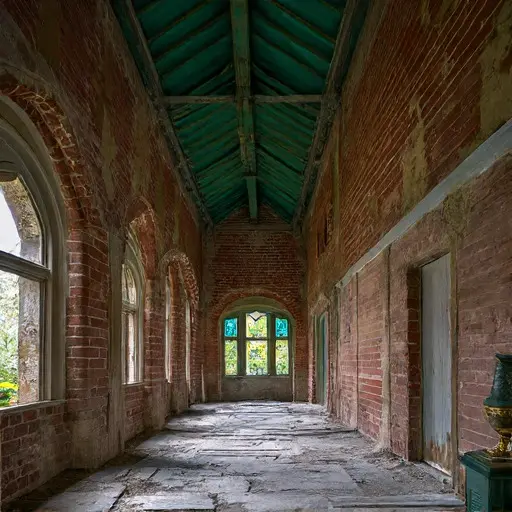
The manor sat angled against its own courtyard like it had once been positioned mid-conversation with the landscape. Nothing about its geometry felt static. The oriel windows projected outward like paused gestures, and the chimney stacks rose in clustered formations that gave the roofline a sense of restrained motion.
It belonged to the Hargrove estate, though locals rarely spoke of it as a single ownership. Instead, it was described as a place that “worked with time rather than against it.” Deliveries, gatherings, and small seasonal rituals were said to move through it continuously, as if the house had once functioned like a living corridor between people and garden.
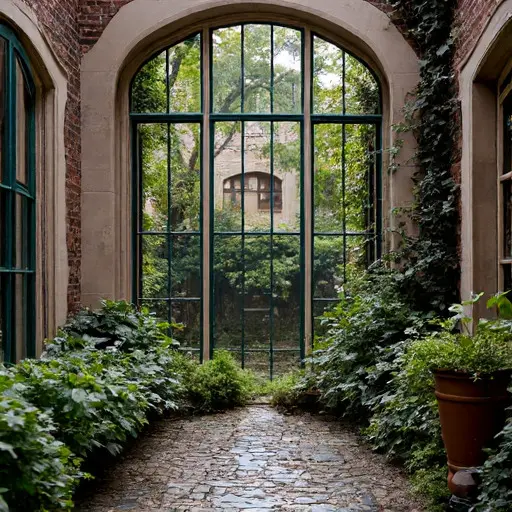
The courtyard itself feels less like an exterior space and more like a held breath between rooms. The marble fountain of the resting stag remains at its center, its surface dulled but still composed, as if waiting for footsteps that knew its exact circumference.
Around it, the garden continues its slow, unhurried language. Marigolds lean into asters, asters into peonies, each layer overlapping without urgency. The grape arbor along the wall forms a shaded corridor that feels less grown and more accumulated, as though every vine arrived with a memory attached.
Even the slightly ajar cobalt gate feels intentional, not broken—just paused at the moment of passage. And though no one moves through it now, the manor still reads like a system of pathways designed for continuity rather than closure.