The Frostveil Castle House Where Winter Forgot to Leave
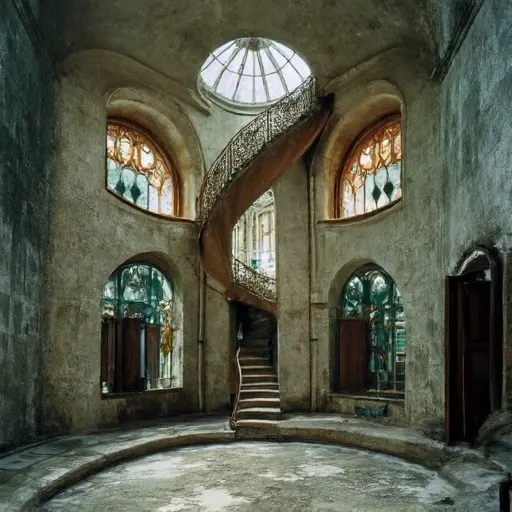
Frostveil Castle stood at the edge of a northern forest where snowfall arrived early and lingered long after the rest of the valley had thawed. Its compact Victorian design gave it a layered, tiered silhouette that seemed to compress warmth into architecture, as if the building itself resisted the climate by becoming denser and more inward-facing over time.
It was built for the Ellingwood family, winter botanists who studied alpine flora surviving beneath extreme cold.
The central octagonal tower was designed as an observation chamber where changing snowfall patterns could be tracked across the forest edge. The two asymmetrical wings served different purposes: one for research and storage, the other for living quarters shaped around long periods of seasonal isolation.
Life in the house followed winter rhythms more than human schedules. Mornings began slowly, with light filtering through snow-muted windows while records were updated and plant specimens catalogued. Afternoons often blurred into quiet maintenance tasks—repairing frost-damaged seals, adjusting greenhouse humidity, or simply observing the stillness outside.
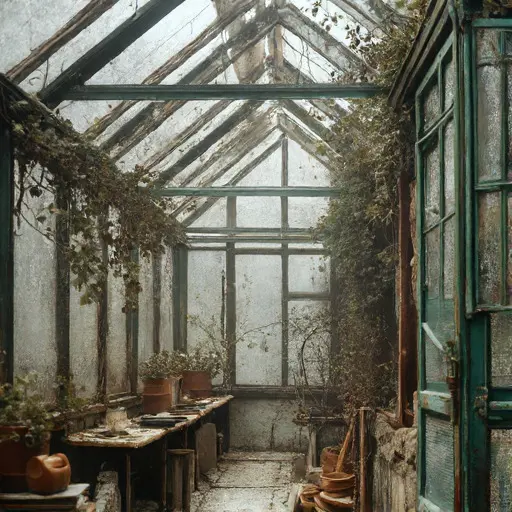
The decline began not with neglect but with isolation. Supply routes became unreliable during harsher winters, and maintenance crews could no longer reach the estate consistently. The Ellingwoods adapted at first, conserving heat, reducing occupied space, and relying more heavily on the greenhouse systems that had once supported their research.
Over time, however, sections of the house were closed off to preserve structural integrity. Entire corridors fell into disuse, and the once-active observation tower became intermittently inaccessible during heavy snow cycles. Communication with the outside world diminished gradually, replaced by delayed correspondence that often arrived after conditions had already changed.
Still, the house did not feel abandoned during these years. It felt suspended, as though waiting for a thaw that never fully came.
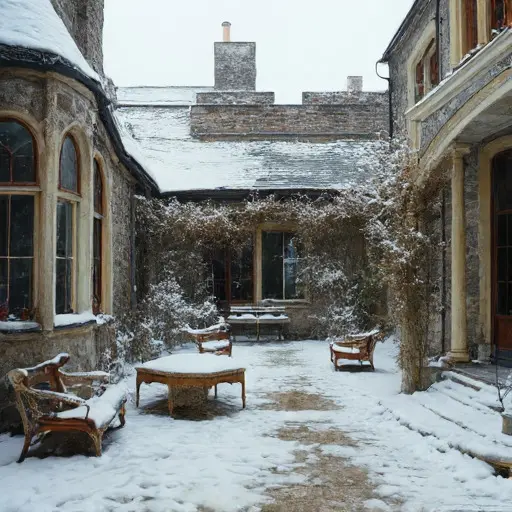
By 1951, Frostveil Castle was fully abandoned. The Ellingwood family never returned after their final departure south, and no subsequent ownership attempt succeeded due to the extreme climate and logistical isolation of the site. Legal claims were left unresolved as interest in maintaining the estate gradually faded.
No restoration followed. Snow continued to accumulate in the courtyard, the greenhouse remained intact but dormant, and the forest slowly extended its edge toward the terraces. Yet even in abandonment, the house retains its seasonal patience—less a ruin than a structure still waiting for conditions that might allow life to resume.