The Ravelcourt Townhouse Where Daily Life Never Fully Stopped
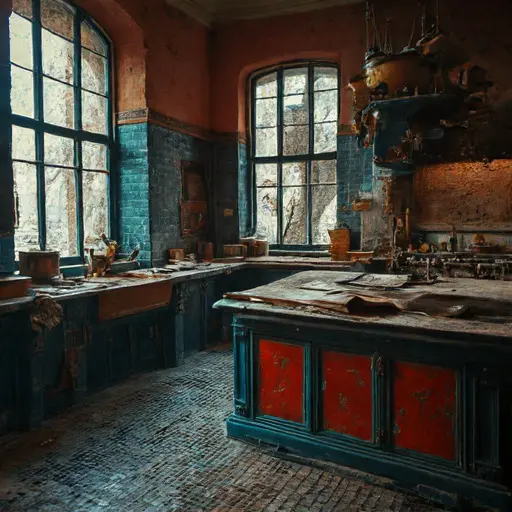
The Ravelcourt House stood at the edge of a slowly shifting urban boundary where city noise faded into quieter residential streets and then into scattered gardens that gradually reclaimed their own geometry. It was built in the late Victorian Renaissance Revival style but interpreted with unusual fluidity—walls that did not align perfectly, window heights that changed subtly from floor to floor, and a roofline that alternated between strict parapet and softened slope. From a distance it appeared ordered; up close, it behaved like something slightly unsettled but still intact.
It became home to Daniel Ravel, a railway surveyor known for measuring routes that rarely followed straight lines, and Liora Hale, a botanical illustrator who preferred documenting plants in transitional states—buds, decay, regrowth. They arrived together after a long period of correspondence that had begun as professional exchange and slowly shifted into something less definable. The house was not chosen for romance, but it became its container nonetheless.
Their life settled into patterns that felt almost architectural in themselves. Daniel maintained the structure, repairing small inconsistencies in brick and frame alignment, while Liora cultivated the narrow side garden, training vines along improvised trellises that leaned into the house rather than away from it. Evenings were often spent on the small bench by the water basin, listening to the sound of leaves falling into still stone water.
Over time, the house absorbed their routines so completely that it began to feel less like a place they lived in and more like a system that depended on them to remain coherent.
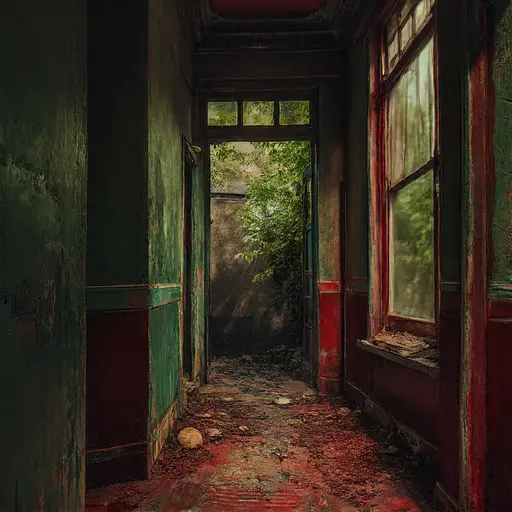
By the late 1920s, the Ravelcourt House entered a slower phase of life that was not marked by a single collapse but by gradual withdrawal from maintenance. Daniel’s surveying work increasingly required travel beyond the city, often for months at a time, leaving Liora to manage both the house and the expanding garden alone. Their correspondence continued, but it became irregular, sometimes overlapping, sometimes delayed to the point of irrelevance.
The side garden grew beyond its intended narrow geometry. Tomato vines and violet beans climbed higher than the trellises could support, spilling into window frames. The pergola began to sag inward under the weight of grape vines, and the laundry line remained permanently occupied by faded fabrics that were never fully collected. Even the stone water basin, once carefully maintained, filled slowly with leaves and drifting petals until its surface became indistinguishable from the surrounding garden floor.
Inside, rooms shifted in use rather than disappearing entirely. Some were simply visited less often, their functions absorbed into others. The house did not empty—it redistributed presence unevenly, like a system adjusting to reduced input.
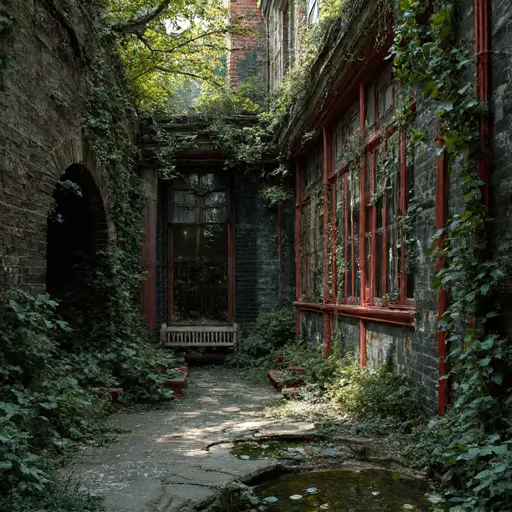
By the early 1940s, after Daniel’s final prolonged absence and Liora’s last unanswered letters, the Ravelcourt House was left without formal closure. There was no recorded sale or decisive departure—only a gradual fading of return visits until they simply stopped occurring.
The structure remained standing at the urban edge, slowly absorbed by its own garden. Vegetation did not destroy it; it threaded through it, following the logic of its original design. The house persisted in an altered state of continuity, holding the imprint of daily life in objects that were never removed and paths that were never fully abandoned, as if waiting for routines that would never resume.