The Selyra Valley House Where Domes Remembered Love
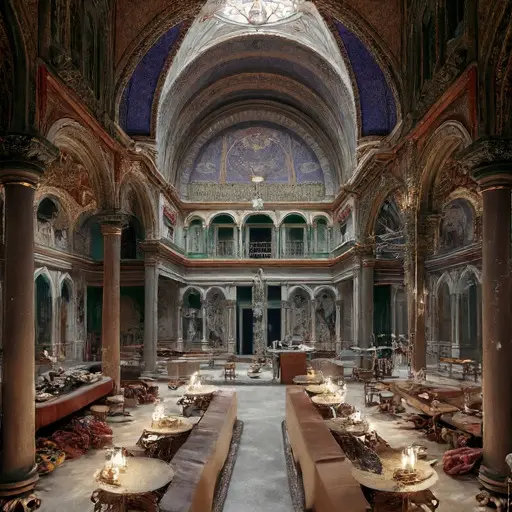
The Selyra House was constructed along a forest valley where mist settled into the landscape like a second atmosphere, softening everything it touched. Its design rejected strict symmetry in favor of a flowing architectural logic inspired by Byzantine sacred forms, reinterpreted for domestic life. The central domed volume rose like a memory made physical, while the surrounding wings curved inward slightly, as if the entire structure were drawn toward its own heart.
It became home to Elias Korran, a stonemason who had spent much of his life restoring ancient ruins, and Mira Solenne, a textile artist whose work often depicted intertwined human figures suspended in motion. They met during the early phases of construction when Mira was documenting the valley’s vegetation for design motifs and Elias was adjusting the curvature of the domed vaults to accommodate natural light patterns. Their connection formed quietly, built less on declaration and more on shared observation—how stone, light, and plant life could all be translated into something that felt like belonging.
When they moved in, the house already felt inhabited by intention. Daily life unfolded through repetition: Mira working in the conservatory sketching climbing vines as they evolved across seasons, Elias refining stone joints in the colonnades to better echo the rhythm of the valley wind. Even their silences felt coordinated, as if the architecture itself encouraged proximity without demand.
By the late 1920s, separation entered the Selyra House not as rupture, but as gradual displacement. Elias began accepting restoration commissions in distant monasteries and civic ruins, drawn away for longer stretches of time. Mira remained within the valley more consistently, tending to the conservatory and continuing her work on textile patterns that increasingly mirrored architectural forms rather than human figures. Their communication continued through letters, but the rhythm changed—less immediate, more reflective, often arriving after the moment they referred to had already passed.
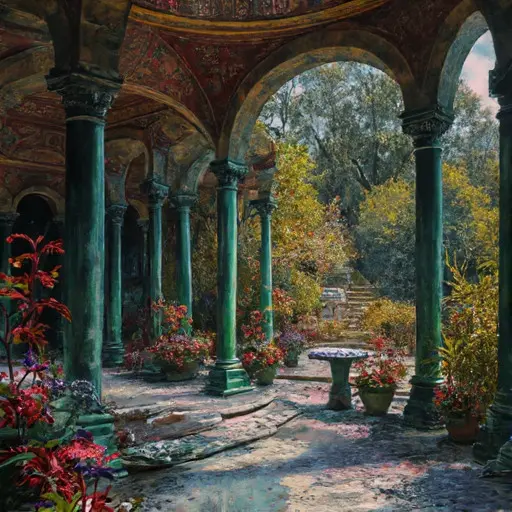
The house absorbed this temporal shift without losing coherence. Rooms that once held shared activity became more individually occupied, yet still visually connected through arched sightlines and curved thresholds. The garden terraces below began to expand beyond their intended geometry, with electric crimson peonies, saffron orchids, and ultramarine vines overtaking mosaic pathways. The growth was not destructive at first—it followed the architecture like memory following habit.
At the center of the estate, the circular reflecting basin remained unchanged in purpose but altered in condition. Black marble edges became softened by moss, and still water gathered drifting petals that never fully dispersed. The sculpture of the two figures beneath a shared cloak stood beside it, no longer simply observed but increasingly surrounded, as if the garden was slowly learning their posture.
By the early 1940s, after Elias’s final absence and Mira’s last unanswered correspondence, the Selyra House was left without formal closure. There was no documented transfer of ownership, no decisive departure—only a gradual cessation of return visits that never reversed.
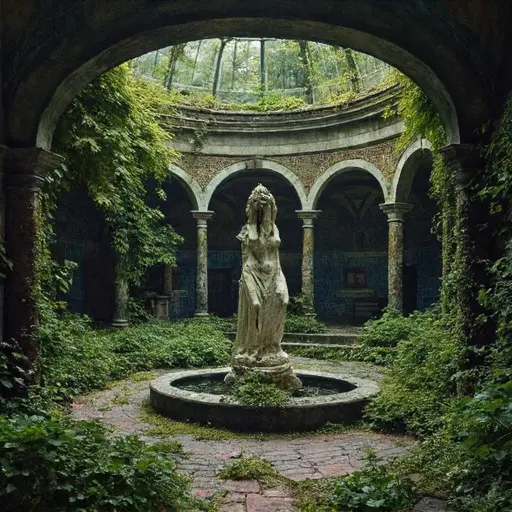
The structure remained intact within the valley, slowly absorbed by its surroundings. The forest did not erase it; it incorporated it. Vines followed domes, terraces, and colonnades as if retracing familiar paths. The house continued to stand, not as a ruin in the conventional sense, but as a preserved emotional architecture—holding the quiet outline of two lives that had once moved through it together, and never quite stopped doing so.