The Viremont Lakeside House Where the Garden Never Forgot
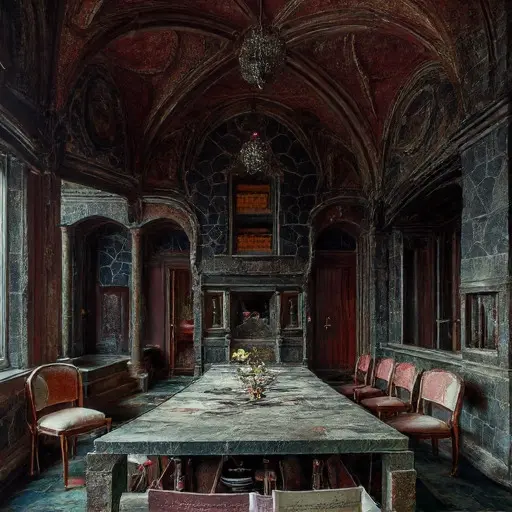
The Viremont House was built at the edge of a still lake where the shoreline curved like a slow breath against dense woodland. Unlike conventional Victorian Romanesque structures, it was reinterpreted by its original designer—an architect known for abandoning straight lines in favor of organic continuity, said to have been inspired by memory rather than geometry. The result was a residence that felt less constructed than grown: archways that changed height as one moved through them, walls that subtly swelled and receded, and a central courtyard spine that acted like a pulse running through the structure.
It was home to Elian Moreau, a quiet industrial surveyor, and Clara Vey, a sculptor whose work focused almost entirely on paired human forms—figures caught mid-embrace, never fully resolved, always slightly incomplete. Their relationship was not dramatic in its beginnings; it formed slowly, like sediment settling in water. They filled the house with shared routines: morning walks along the circular glass-tiled courtyard path, afternoons spent adjusting small architectural details together, evenings where Clara shaped clay while Elian read aloud without being asked.
The estate became known locally not for its architecture alone, but for the feeling that nothing inside it ever truly ended. Even disagreements seemed to dissolve rather than resolve. The embracing sculpture at the center of the basin was originally modeled after no specific moment, yet neighbors insisted it resembled them both in different ways depending on the light.
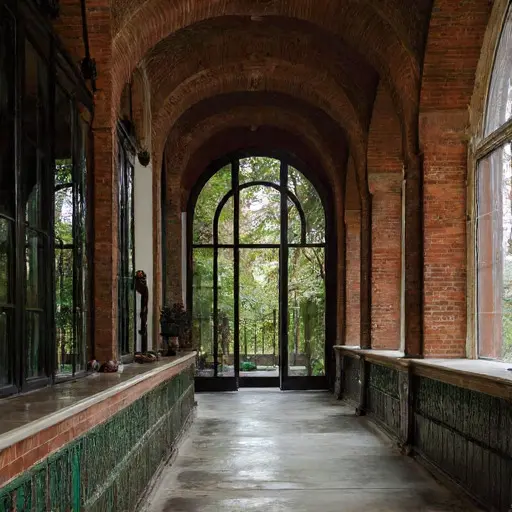
By the late 1920s, the Viremont House began to shift in tone as external pressures slowly reached its curved interior world. Elian’s work required longer absences, sending him to distant shoreline infrastructure projects that stretched across seasons rather than weeks. Clara remained behind more often, spending increasing hours in the conservatory, where she began creating variations of the same embracing form—each slightly different, as if searching for a version that would not eventually drift apart.
Their correspondence continued, but it changed in texture. Less immediate, more reflective. Letters began to overlap—sent before the previous ones were answered. The house absorbed this rhythm without resistance. Rooms that once held conversation began to hold delay instead, as if waiting itself had become part of the architecture.
The garden, meanwhile, refused to interpret absence as loss. It expanded into the circular courtyard path, swallowing sapphire, jade, and amethyst glass tiles beneath layers of petals and creeping vines. The embracing sculpture remained untouched at the basin’s center, now surrounded by drifting violet blooms that collected in the water like slow punctuation.
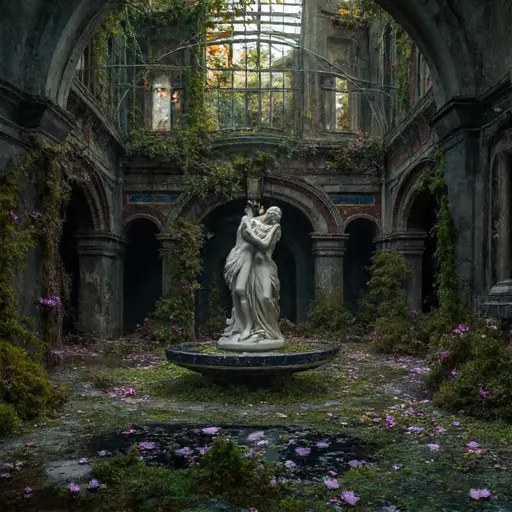
By the early 1940s, after prolonged separation and unresolved correspondence that never fully became closure, the Viremont House was left unclaimed. There was no formal departure that anyone could point to—only a gradual fading of presence until the rooms stopped receiving return visits.
No restoration was attempted, and no ownership dispute ever fully concluded. The house remained exactly as it was, as if waiting for a continuation that never arrived. The lake continued to move beside it, the garden continued to grow through it, and the embracing sculpture remained at the center of the basin—no longer a depiction of two figures together, but of something the world refused to let fully separate.