The Curved Memory House Above the Bellflower Slope
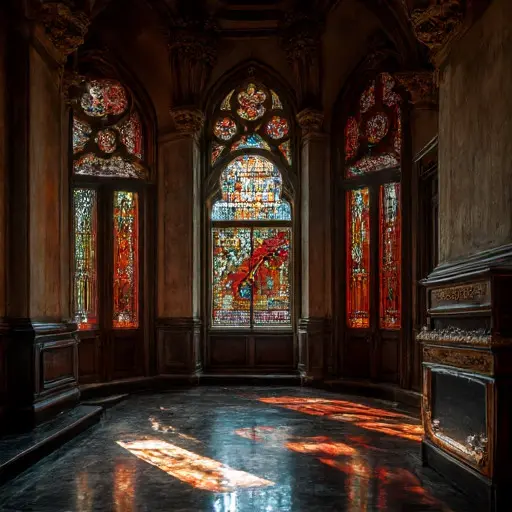
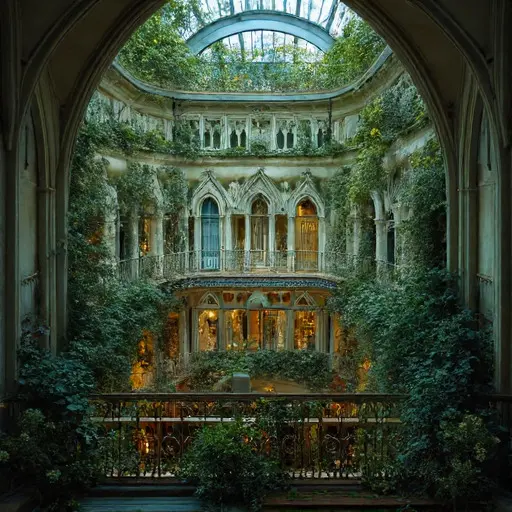
Wide hillside forest-edge view of an abandoned Victorian Gothic Revival townhouse subtly distorted into a graceful, buildable curvature, where architectural lines soften into controlled organic motion. The walls gently taper and bow inward as they rise, a tall lancet-windowed façade subtly leaning toward a central vertical spine, while clustered gables lift at slightly offset angles, creating a dynamic but structurally plausible asymmetry. The exterior is composed of luminous pearl-gray stone contrasted with saturated cobalt slate roofing, deep emerald enamel window frames, and vivid crimson stained-glass panels set within pointed arches, all refined with antique gold tracery and polished black iron detailing that remains intact despite time and weather.
The surrounding grounds feel intensely intimate, as though the estate still holds emotional continuity. A looping stone garden path inlaid with sapphire and emerald glass winds through dense, deliberate plantings of electric magenta peonies, bright saffron lilies, and ultramarine bellflowers that spill over the edges of the walk.
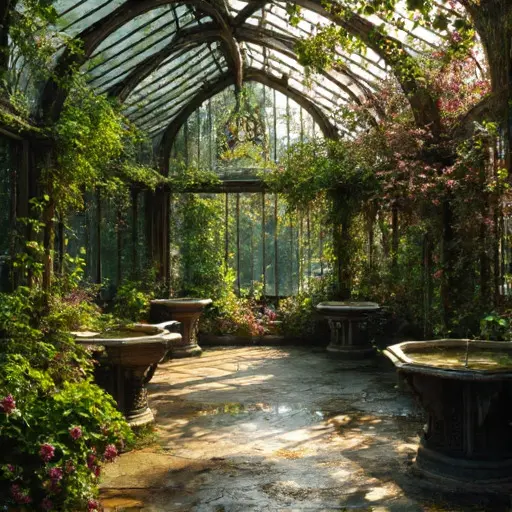
At a gentle rise in the garden, a marble statue of two figures standing close with intertwined hands rests beneath a sweeping wrought-iron arch engulfed in heavy violet wisteria clusters, their weight bending the structure into a soft floral canopy. Nearby, a circular reflecting basin lined in deep teal tile holds perfectly still water scattered with rose petals, mirroring the warped façade above. A small glass conservatory with subtly distorted arched ribs leans into surrounding grapevines, its panes clouded and fractured but still catching fragments of light, reinforcing the sense of a place preserved more by memory than by abandonment.