The Casa del Sol Quietus of the Iberian Courtyard
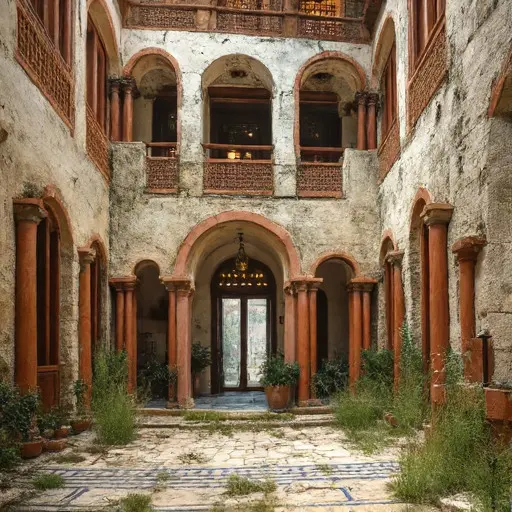
The Casa del Sol Quietus was commissioned in the late 19th century by an Iberian maritime family seeking to reinterpret Moorish architectural heritage through the lens of Victorian spatial order. The design merges Andalusian courtyard logic with Victorian symmetry, resulting in a hybrid structure centered around a sunlit interior void rather than a dominant façade. The horseshoe-arched loggia forms the primary threshold between interior and exterior worlds, while flanking wings extend in asymmetrical balance to accommodate residential and ceremonial functions.
Materials were chosen for both symbolic and climatic resonance: ivory stucco to reflect heat and diffuse light, cobalt ceramic tiles for visual rhythm and cultural reference, and terracotta accents to ground the structure in regional construction traditions.
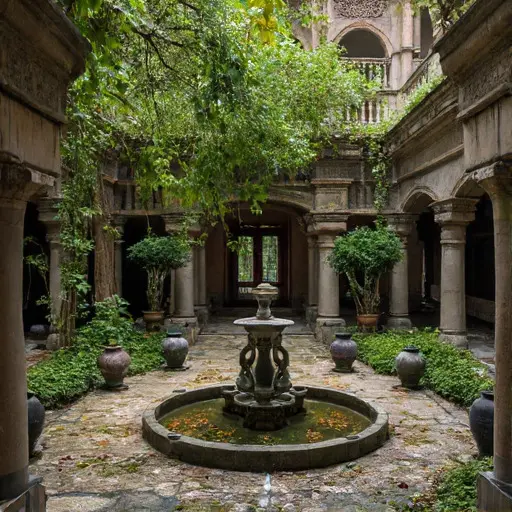
By the early 20th century, the Casa del Sol Quietus entered a gradual phase of decline following the disruption of maritime trade routes that supported its founding family. Without sustained maintenance, the delicate balance between stucco surfaces, ceramic inlays, and bronze latticework began to erode under seasonal moisture and plant encroachment. The courtyard mosaic, originally designed as a precise geometric expression of solar order, slowly fractured into irregular fragments as moss and grass colonized the joints. Citrus trees expanded beyond their intended boundaries, their growth subtly altering circulation paths and visual axes. The arcaded galleries remained structurally intact but increasingly merged with vegetation, as vines began to trace the original architectural rhythm of arches and columns.
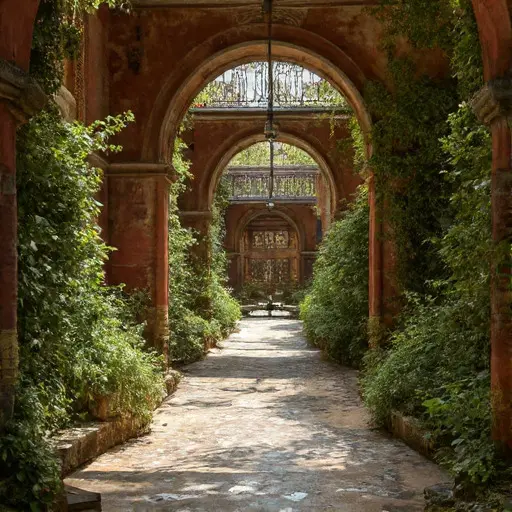
In its present condition, the Casa del Sol Quietus exists as a stabilized convergence of architectural intent and ecological transformation. Its Iberian Revival identity remains legible through courtyard geometry, material palette, and rhythmic arcade composition, even as nature gradually redefines spatial boundaries. Rather than collapsing into ruin, the estate has transitioned into a hybrid environment where design logic persists within natural systems. The result is a continuous interplay between sun-oriented architecture and organic reclamation, where stone, tile, water, and vegetation form a single evolving structure.