The Vintergaard Arctic Manor Beneath the Frozen Light
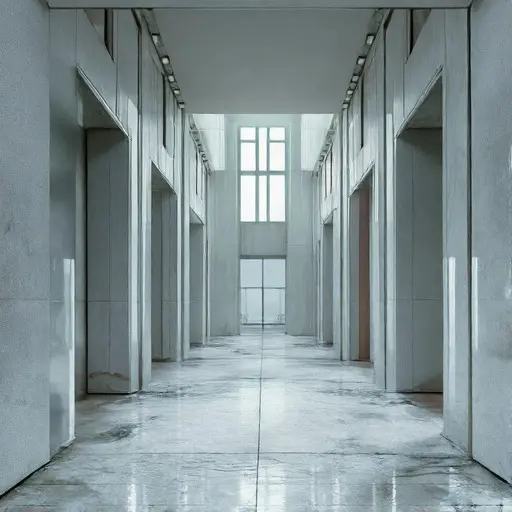
The Vintergaard Manor was constructed in the late 19th century during a period of northern architectural experimentation, when designers sought to adapt Victorian formalism to extreme cold-climate conditions. Commissioned by an Arctic trade consortium, the structure was intended as both a residential stronghold and a symbolic representation of human endurance in harsh environmental conditions. Its compact fortified silhouette and steep layered roof planes were engineered specifically for heavy snow accumulation, allowing the structure to shed weight naturally while maintaining strict symmetrical integrity.
The pale glacier stone was quarried from northern bedrock formations known for their dense crystalline structure and subtle blue refraction under low-angle light.
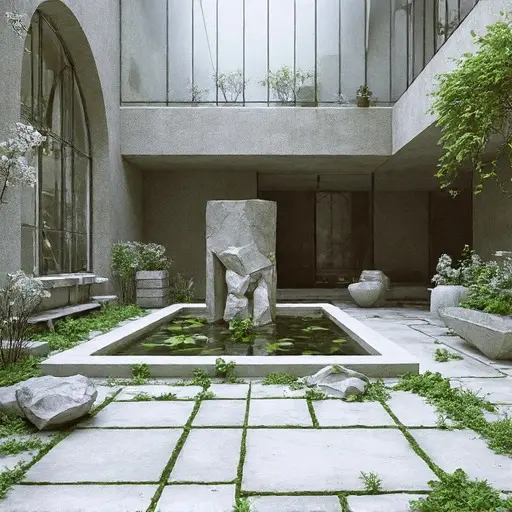
By the early 20th century, the Vintergaard Manor entered a prolonged period of abandonment following the collapse of the Arctic consortium’s trade routes and logistical networks. Without active maintenance, the steel detailing began to cool further into matte oxidation, while aquamarine glass panels accumulated surface clouding from repeated freeze-thaw cycles. The courtyard’s strict geometric slab system remained intact but gradually softened as moss colonization spread through microfractures in the stone. The fragmented conservatory structure began to fail under snow load, its glass ribs collapsing inward and forming open channels for wind-driven vegetation. Despite these changes, the underlying architectural order remains clearly legible.
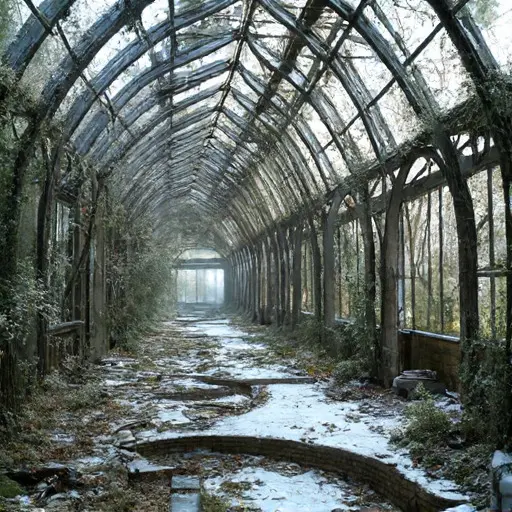
In its present condition, the Vintergaard Arctic Manor persists as a stabilized architectural ruin shaped equally by design intent and climatic forces. Its fortified symmetry, cold material palette, and engineered snow-response systems remain intact, even as nature slowly infiltrates the finer structural gaps. The estate no longer functions as an inhabited residence but as a long-duration equilibrium between stone, steel, ice, and vegetation. Within this balance, the manor continues to express its original Arctic logic—one of endurance, restraint, and quiet adaptation to an uncompromising environment.