The Karsfeld Industrial-Gothic Manor of the Silent Forecourt
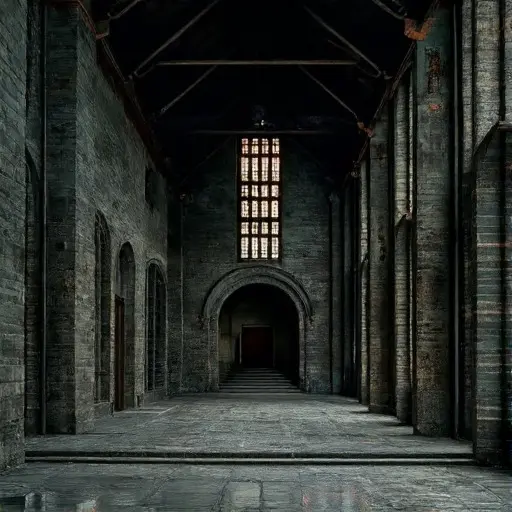
The Karsfeld Manor was constructed during the late industrial expansion period of the 19th century, when architectural firms began merging Gothic revival language with emerging industrial material systems. Commissioned by a metallurgical consortium, the building was intended as both administrative headquarters and symbolic monument to industrial permanence. Its design emphasized structural honesty expressed through monumental scale, with buttressed corners and reinforced steel elements exposed rather than concealed.
The basalt masonry was sourced from regional quarry networks known for their density and tonal uniformity, while the oxidized steel panels were intentionally left untreated to allow controlled environmental patination. The result was a hybrid aesthetic of medieval fortress and industrial apparatus.
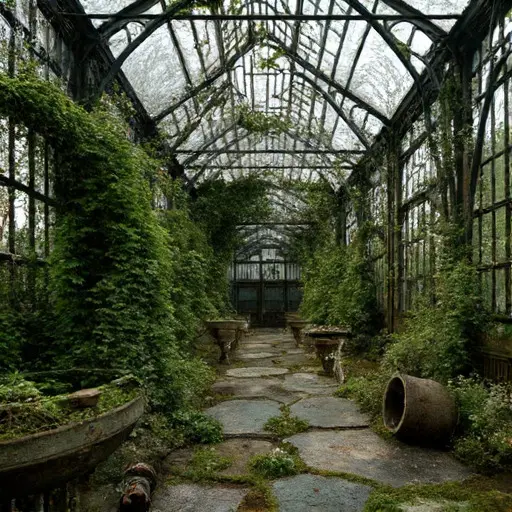
By the mid-20th century, the Karsfeld Manor began its gradual abandonment following the dissolution of the industrial consortium and the relocation of administrative operations. Without active maintenance, the reinforced steel elements began to oxidize further, deepening their green patina while exposing structural seams to moisture infiltration. The once-rigid forecourt geometry softened as grasses and moss spread through the cracked slate paving, subtly disrupting the intended industrial order. The central stone plinth sculpture remained intact, though increasingly surrounded by encroaching vegetation that recontextualized its abstract human form within a natural setting. The greenhouse wing collapsed in stages, its iron frameworks gradually losing glass infill and structural tension.
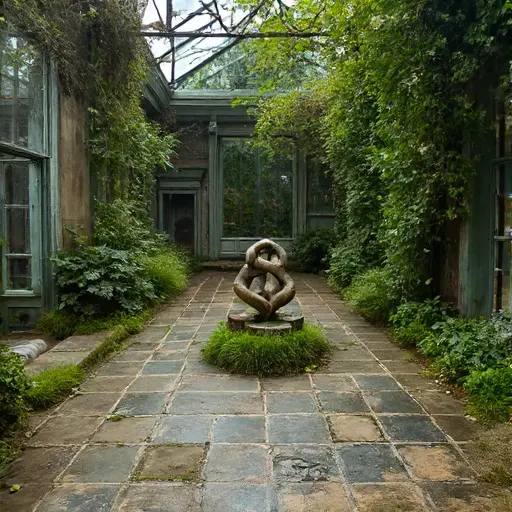
In its present condition, the Karsfeld Industrial-Gothic Manor exists as a stabilized ruin where industrial rigor and natural reclamation have reached a fragile equilibrium. The original fortress-like composition remains fully legible in its massing and structural hierarchy, yet its surfaces now carry the accumulated evidence of environmental transformation. Rather than disappearing, the architecture has adapted into a hybrid state, where basalt, steel, moss, and vegetation coexist within a shared spatial system. The manor stands not as a failed industrial monument, but as a long-duration transition between engineered permanence and organic continuity.