The Palazzo Miralume of the Silent Water Terrace
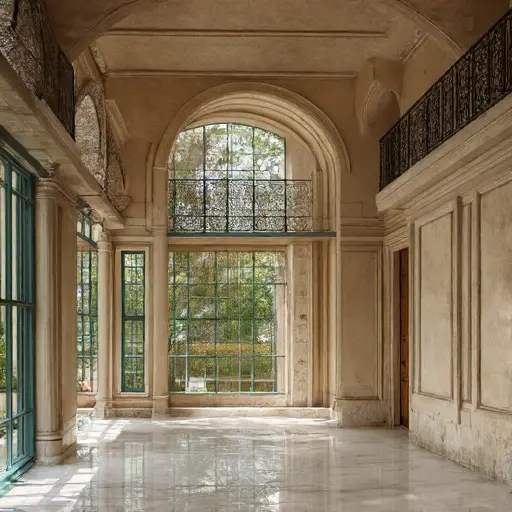
The Palazzo Miralume townhouse was completed in the late 19th century as part of a brief revival of Venetian-inspired domestic architecture in Northern Europe, commissioned by a shipping magnate family seeking to recreate the spatial poetry of lagoon palaces within a colder continental climate. The design prioritized vertical layering and reflective surfaces, translating the logic of canals, light, and water into architectural form. Cream limestone was chosen for its ability to soften daylight, while imported Venetian glass was embedded directly into structural window surrounds to create a continuous interplay between interior and exterior illumination.
The rose-pink marble bands were introduced as a stabilizing visual rhythm, echoing the horizontal stratification of historic palazzi along the Grand Canal.
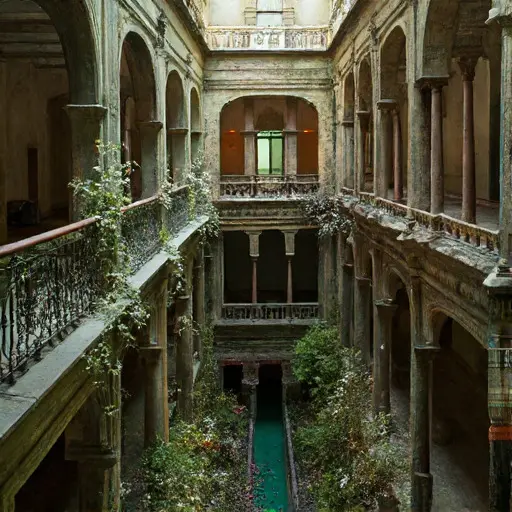
By the early 20th century, the Palazzo Miralume entered a gradual phase of abandonment following the decline of the family’s maritime holdings and the increasing maintenance demands of its complex water-integrated design. Without regular upkeep, the canal-like reflecting basin slowly expanded beyond its intended boundaries, submerging lower courtyard steps and altering circulation between interior levels. Ornamental mosaics near ground level began to fracture as moisture permeated the structural foundation, while jasmine and ornamental grasses established themselves along the terrace edges. The architecture did not collapse so much as transition into a partially submerged state, where water and vegetation became secondary structural elements within the original design logic.
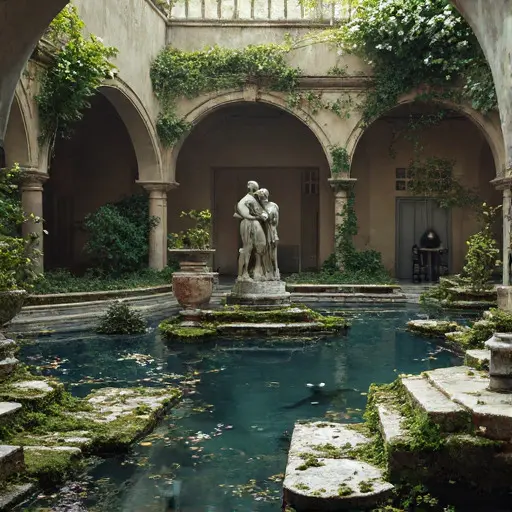
In its current state, the Palazzo Miralume persists as a hybrid architectural-aquatic environment where design intent and environmental transformation remain inseparable. The Venetian Revival structure continues to express its original principles of reflection, symmetry, and layered spatiality, even as water levels and vegetation alter its physical boundaries. Rather than decaying into ruin, the townhouse has evolved into a slow-moving equilibrium between stone, glass, and water. The result is a living palimpsest of architectural memory, where the logic of the Venetian palazzo survives in an altered, submerged form.