The Løvenholm Rococo Townhouse of the Quiet Northern Garden
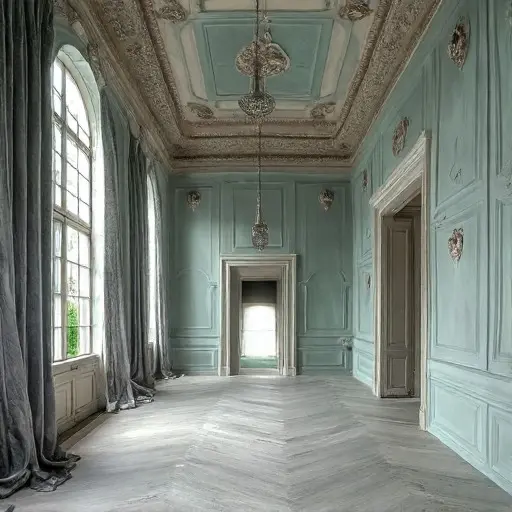
The Løvenholm townhouse was constructed in the late 18th century during a rare northern interpretation of Rococo architecture, where Scandinavian restraint reshaped the exuberance of continental ornamentation into something quieter, colder, and more geometrically controlled. Commissioned by a maritime trading family with ties to Baltic commerce, the residence was intended as both a domestic retreat and a symbolic representation of cultivated refinement at the edge of the northern forests. Its design philosophy emphasized softened curvature over excess decoration, resulting in a façade that appears ornate at first glance but resolves into measured balance upon closer inspection.
The pale mineral plaster was mixed with crushed shell pigments to achieve its signature opalescent blue tone, while silver leaf detailing was applied sparingly to avoid visual weightlessness in the northern light.
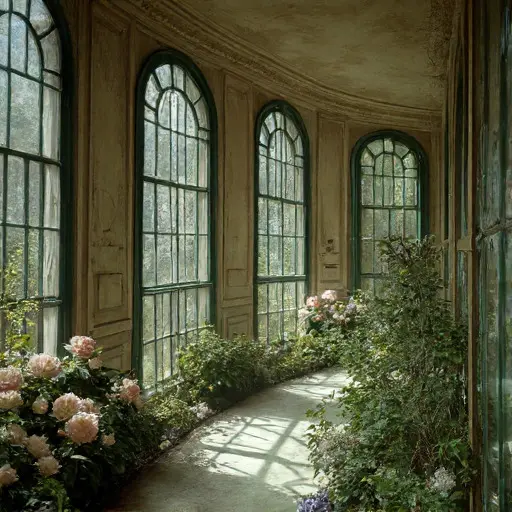
By the early 20th century, the Løvenholm townhouse entered a gradual decline following the dissolution of the family’s shipping interests and the relocation of its final occupants. Maintenance of the delicate mineral plaster and silver leaf ornamentation became increasingly sporadic, leading to slow weathering of both interior and exterior surfaces. The formal oval courtyard, once carefully maintained as a controlled ornamental garden, began to soften at its edges as plant life expanded beyond intended borders. Pathways designed with flowing Rococo curvature were gradually overtaken by moss and creeping flora, which followed the same organic logic as the architecture itself. Rather than collapsing into ruin, the estate transitioned into a state of aesthetic continuity between design and nature.
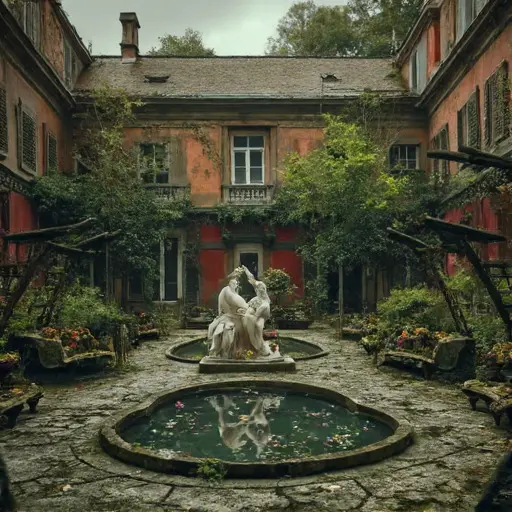
In its current state, the Løvenholm townhouse persists as a living architectural memory at the boundary between cultivated design and natural succession. Its Rococo structure remains legible through curvature, symmetry, and material contrast, even as vegetation progressively integrates itself into every ornamental layer. The estate no longer functions as a residence in any conventional sense, but rather as a hybrid environment where architecture continues to evolve under ecological influence. Within the oval courtyard, water, stone, and plant life have reached a quiet equilibrium, preserving the original compositional intent in an altered, softened form.