The House of Amun-Serekh Beneath the Quiet Reed Garden
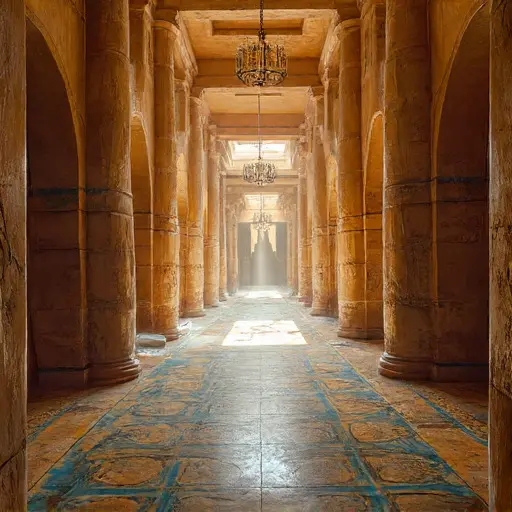
The Neo-Egyptian manor known as the House of Amun-Serekh was completed in the late 19th century during a period of European fascination with archaeological discovery along the Nile. Commissioned by an industrial patron deeply invested in antiquities and symbolic architecture, the estate was conceived not as a domestic residence alone, but as a terrestrial echo of a sacred complex. Its design draws heavily on monumental temple forms, with axial precision dictating every approach, corridor, and courtyard alignment.
The sandstone façade was sourced and carved to emphasize weight and permanence, while the lapis-blue tile inlays were intended to evoke celestial association and ritual depth. From its inception, the manor functioned as both residence and curated artifact, blending lived space with constructed mythology.
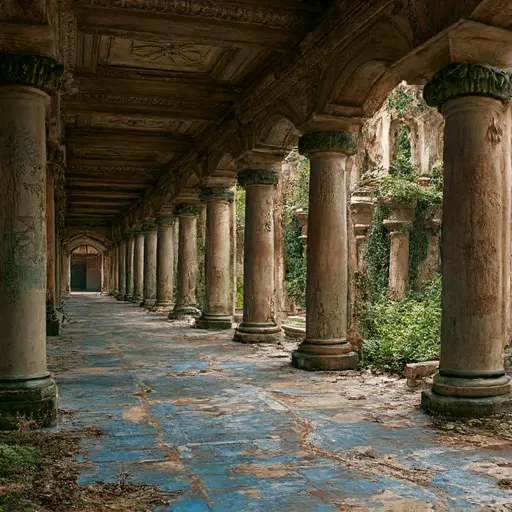
By the early 20th century, the House of Amun-Serekh entered a prolonged period of decline following the dissolution of its founding family’s fortunes and the dispersal of its antiquities collection. Without sustained maintenance, the delicate balance between monumental stonework and decorative surface systems began to degrade. Water infiltration along rooflines darkened sandstone reliefs, while bronze fixtures oxidized further into irregular green-black tones. The axial reflecting basin, once carefully maintained, slowly expanded into a still flooded forecourt where lotus and reed species established themselves beyond control. The colonnaded loggias, designed for ceremonial procession, became partially submerged in encroaching vegetation, transforming formal pathways into hybrid corridors of stone and marsh.
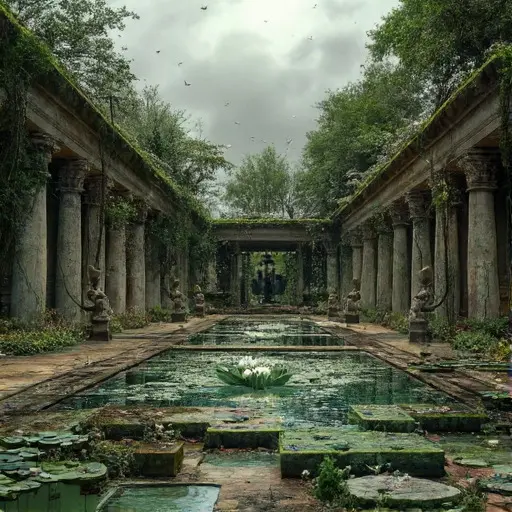
In its present state, the House of Amun-Serekh exists as a partially submerged architectural relic at the edge of a self-formed wetland ecosystem. Despite abandonment, its underlying axial geometry remains perceptible, guiding the eye through corridors, basins, and colonnades that still align with ritual precision. Nature has not erased the structure but instead adopted its framework, allowing reeds, lotus, and vines to follow the original design logic of symmetry and procession. The result is a layered environment where human intention and natural succession are no longer distinct, but continuously intertwined across stone, water, and time.