The Lysandre Art Nouveau Townhouse Beneath the Blooming Stone Facade
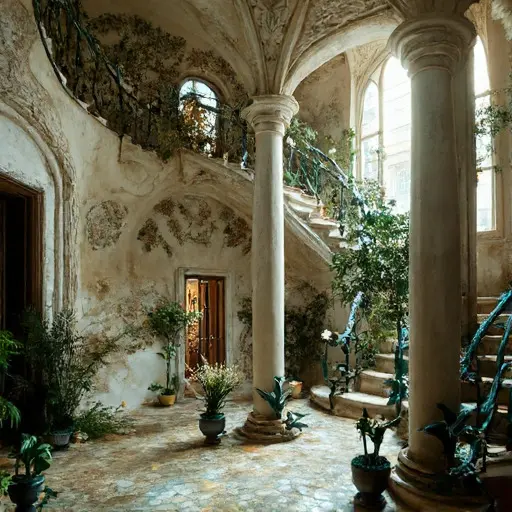
The Lysandre House was completed in 1892 during the height of the Art Nouveau movement, commissioned by the Delacroix family as an architectural experiment in total design unity. Unlike conventional townhouses of the period, it was conceived as a single continuous organism, where structure, ornament, and interior function were inseparable. Every balcony, cornice, and window was designed to resemble botanical growth, expressing the philosophy that architecture should mirror natural systems rather than oppose them.
The family used the residence as both home and artistic salon, hosting gatherings of sculptors, painters, and botanists who contributed to its evolving decorative program. The circular garden courtyard was intended as the emotional core of the house, a living extension of its flowing interior forms.
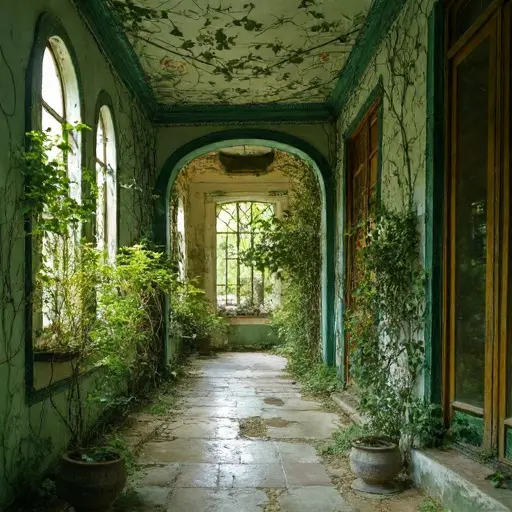
By the early twentieth century, the Delacroix family’s resources declined as industrial shifts reduced the profitability of their artistic patronage and estate holdings. The maintenance demands of the townhouse, with its complex curved plasterwork and integrated bronze botanical structures, proved increasingly difficult to sustain. Repairs were delayed, and the building began to respond visibly to environmental pressure. Copper roof petals oxidized unevenly into turquoise and jade tones, while sections of curved glass in the conservatory cracked and sagged inward. Outside, the circular garden courtyard transitioned from controlled design into a semi-wild ecosystem. Calla lilies, wild orchids, and anemones spread beyond their intended boundaries, while the sculptural fountain slowly filled with rainwater and drifting petals. The marble figures at its center became increasingly wrapped in ivy, their forms softened by vegetation and time.
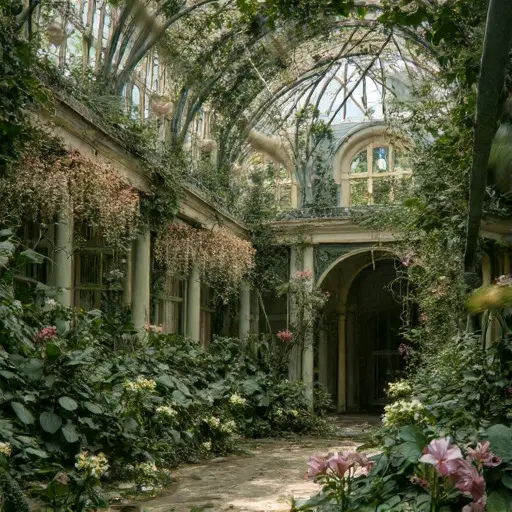
By the mid-1940s, the Lysandre Art Nouveau townhouse was fully abandoned following the final departure of its remaining occupants, with no subsequent restoration attempts undertaken. Ownership remained legally unresolved for decades, allowing the estate to transition into a state of uninterrupted natural transformation. The conservatory became fully integrated into the surrounding vegetation, while interior corridors softened into garden-like environments as plants entered through broken openings. The circular courtyard fountain continued to collect rainwater and petals, evolving into a still reflective basin at the center of the overgrown estate. Today the townhouse still stands beneath a dense overcast sky, its flowing architectural language preserved in softened stone, bronze, and glass, now inseparable from the living growth that continues to reshape it.