The Ravenshollow Queen Anne Country House Beneath the Wild Garden Sky
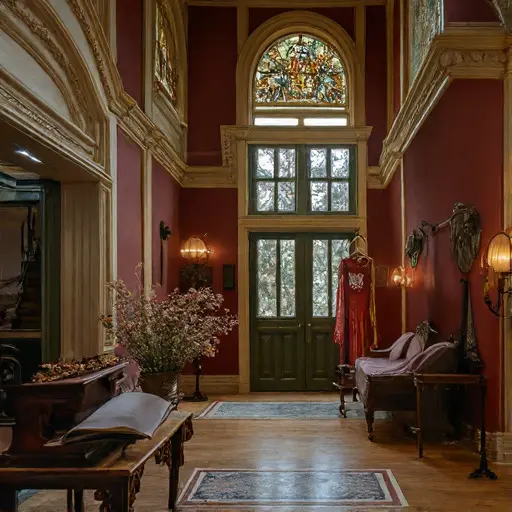
Ravenshollow House was completed in 1888 during the peak of Queen Anne residential expansion into rural estates, commissioned by the Wentworth family as a permanent country residence away from industrial centers. Designed with an emphasis on asymmetry and picturesque complexity, the structure combined stacked verandas, projecting bays, a round turret, and a sunroom extending directly into the surrounding garden landscape. The family that lived here valued both social gathering and quiet domestic rhythm, hosting seasonal events on the lawns while maintaining structured daily life within the house’s many interlocking rooms.
The carriage drive, porte-cochère, and orchard pathways were all designed as part of a continuous domestic environment where architecture and landscape blended seamlessly.
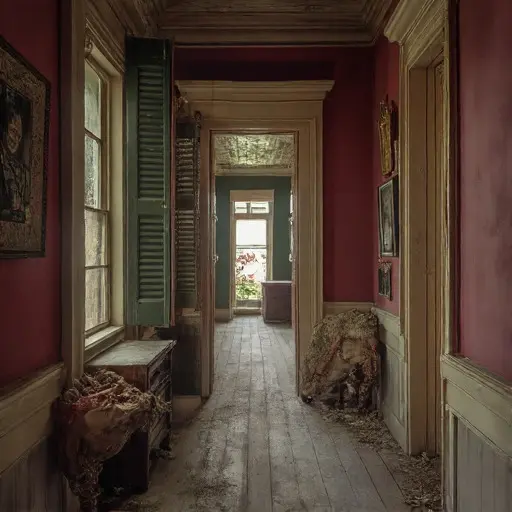
As the decades passed into the early twentieth century, the Wentworth family gradually dispersed due to economic changes and shifting agricultural demands that reduced the viability of maintaining a large country estate. The house, with its complex rooflines and extensive decorative woodwork, required continuous maintenance that became increasingly difficult to sustain. Repairs were delayed, allowing slate shingles to loosen and moisture to penetrate upper floors. Outside, the once-structured garden began to blur into a more natural landscape as foxgloves, hollyhocks, and hydrangeas spread beyond their original beds. The marble sculpture of the dancing couple near the lily pond slowly became enveloped in climbing ivy, while the wooden arbor collapsed under the weight of overgrown grapevines. Even the orchard trees were left unpruned, their branches twisting into dense, unstructured forms that framed the house in an increasingly wild embrace.
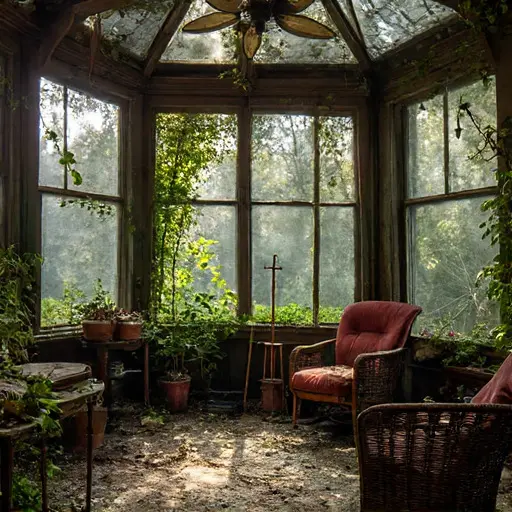
By the late 1940s, following the final departure of its remaining occupants, Ravenshollow House was left fully uninhabited but never formally dismantled. Ownership passed through inheritance without restoration, leaving the estate to slowly transition into a state of natural reclamation. The circular carriage drive became fractured beneath creeping grass and moss, while the porte-cochère softened under layers of lichen and climbing vines. The conservatory’s shattered glass blended almost entirely into the surrounding jasmine growth, and the orchard merged with the edge of the forest as pear and cherry trees grew unchecked. Today the Queen Anne country house still stands from foundation to chimney, its once-vibrant painted façade softened by time, its gardens transformed into a living continuation of memory beneath a quiet, overcast sky.