The Mariselle Art Nouveau Seaside Manor Left Above the Forest Shore
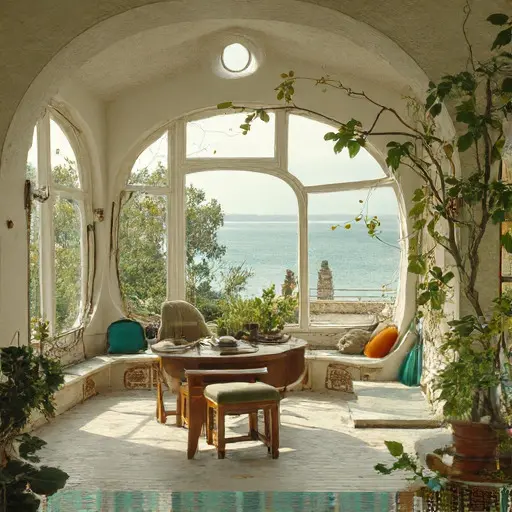
The Mariselle Manor was constructed in the early twentieth century on a coastal forest overlook, commissioned by an independent patron-designer who sought to merge Art Nouveau organicism with practical residential living. Unlike monumental decorative architecture, the house was intentionally scaled as a compact, livable structure, with a central living core that opened fluidly into a small arched veranda facing the sea and forest canopy. The household consisted of a small family supported by a gardener and a caretaker responsible for maintaining both the residence and its highly specialized ornamental plantings.
Daily life revolved around the central living space, where correspondence, design work, and domestic planning were conducted in a continuous rhythm shaped by natural light and seasonal coastal winds. For many years, the manor remained stable, sustained by modest creative commissions and careful maintenance of its intricate materials.
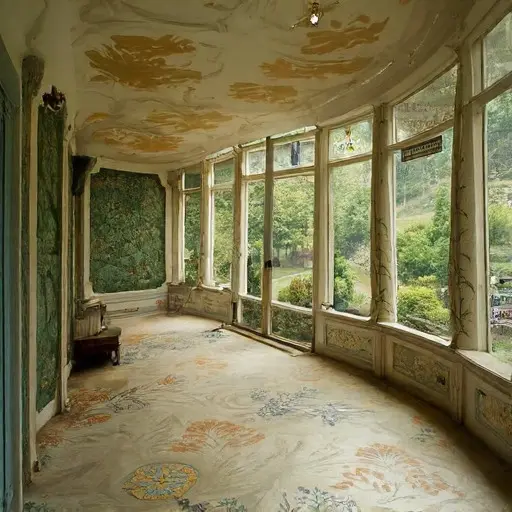
By the late 1920s, the Mariselle Manor began to experience financial strain as commissioned design work declined and the cost of maintaining its highly specialized materials increased. The combination of shell-plaster surfaces, ceramic roofing, and botanical ironwork required constant skilled upkeep, which became increasingly difficult to sustain. Portions of the upper rooms were used less frequently to conserve heating and maintenance resources, leading to a gradual concentration of daily life within the central living core. Garden maintenance also declined, allowing coral lilies, marigolds, and camellias to grow more freely but less formally controlled. Correspondence accumulated without timely response, while household management slowly shifted from attentive care to deferred maintenance. Over time, the manor transitioned from an active artistic residence into a partially maintained structure marked by quiet neglect.
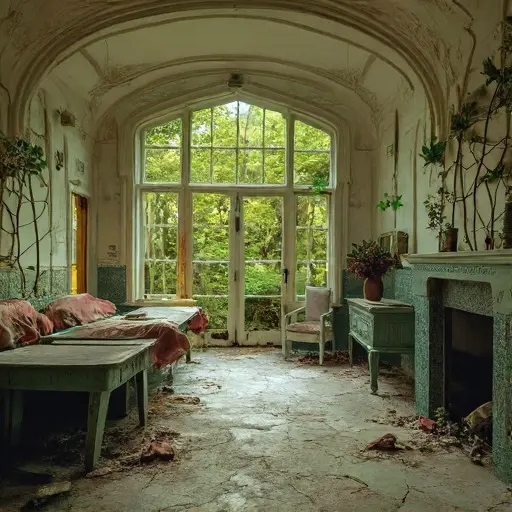
By the early 1940s, following prolonged financial decline and unresolved inheritance complications, the Mariselle Art Nouveau Manor was fully abandoned. No restoration efforts were undertaken, and the property remained in legal uncertainty that prevented any redevelopment or transfer. Vegetation from the surrounding forest and coastal garden gradually merged into the structure, while seasonal weather accelerated erosion of stucco, ceramic, and bronze elements. Interior furnishings and documents were left in place, preserving the final years of decline in quiet detail. No occupants returned, and the manor continues to stand empty above the forest shore, slowly dissolving into its landscape while retaining the memory of its once fluid and harmonious domestic life.