The Casa do Litoral Coastal Manor Left in Quiet Weather
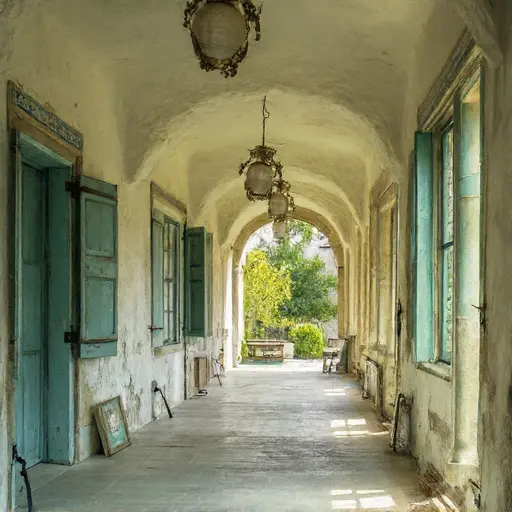
The Casa do Litoral was constructed in the early twentieth century along a sheltered stretch of the Portuguese coastline at the edge of dense forest, commissioned by a small mercantile family whose livelihood depended on fishing contracts, coastal shipping, and modest agricultural holdings inland. Designed with simplicity and symmetry in mind, the manor emphasized ventilation, shaded circulation, and direct connection between interior and courtyard space through its central veranda. The household consisted of a close-knit family supported by a gardener and occasional laborers who maintained both the modest garden and structural upkeep of the property.
Daily life was centered on the veranda, where meals, correspondence, and business records were managed in a calm, regular rhythm shaped by coastal climate and seasonal trade cycles. For many years, the manor remained stable, its restrained design and manageable scale allowing it to function smoothly within its environmental setting.
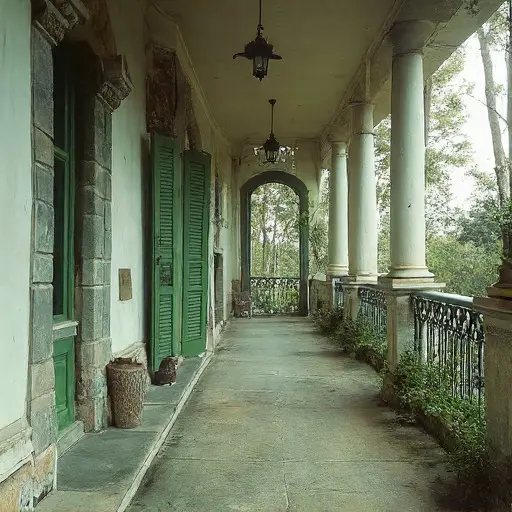
By the late 1920s, the Casa do Litoral began to experience financial strain as coastal trade routes shifted and fishing yields became less reliable. Maintenance of the lime plaster exterior, ceramic tile detailing, and wooden shutters required continuous attention due to exposure to salt air and humidity, but repairs were increasingly delayed. Portions of the upper rooms were used less frequently to reduce upkeep and cooling demands, leading to a gradual concentration of daily life around the ground-level veranda and courtyard. Gardening activity diminished as resources and labor became limited, allowing bougainvillea and hibiscus to grow more freely but less controlled. Financial correspondence accumulated without timely response, and household management gradually shifted from proactive care to delayed maintenance. Over time, the manor transitioned from an active coastal residence into a partially maintained structure marked by quiet neglect.
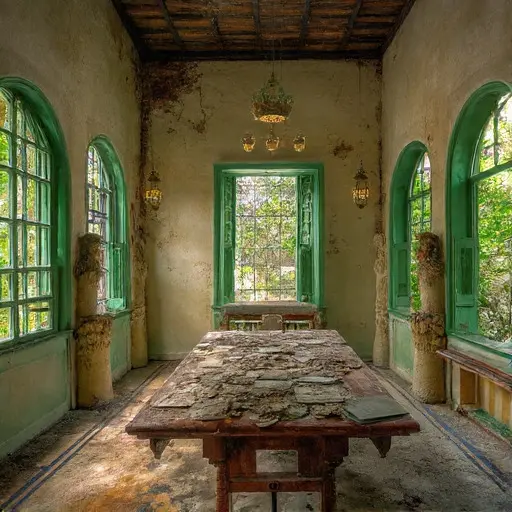
By the early 1940s, following prolonged economic decline and unresolved inheritance matters, the Casa do Litoral was fully abandoned. No restoration efforts were undertaken, and the property remained in legal uncertainty that prevented any redevelopment or sale. Vegetation from the surrounding forest and courtyard gradually merged into the structure, while coastal weathering accelerated erosion of plaster, wood, and ceramic surfaces. Interior furnishings and documents were left in place, preserving the final years of gradual withdrawal in quiet detail. No occupants returned, and the manor continues to stand empty at the forest edge, slowly dissolving into its environment while retaining the memory of its once orderly coastal life.