The Montevaldo Pombaline Palace Left Beyond the Forest Edge
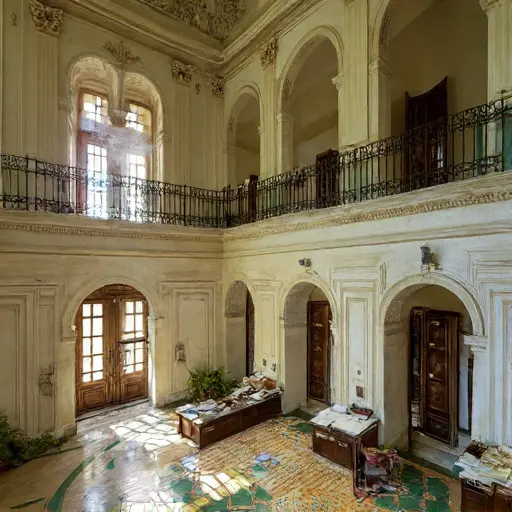
The Montevaldo Palace was constructed in the early twentieth century by a Lisbon-based administrative family whose wealth was derived from port taxation, colonial trade accounting, and inland agricultural estates. Designed in the Pombaline neoclassical tradition, the residence emphasized structural clarity, earthquake-resistant rectilinear planning, and disciplined symmetry across every façade. The household consisted of multiple generations supported by clerks, estate stewards, and domestic staff responsible for managing financial records, land leases, and trade documentation.
Daily operations were centralized in the entrance hall and upper offices, where governance was conducted with bureaucratic precision. The surrounding parterre gardens were carefully aligned with the architecture, extending the strict geometric order into the landscape through patterned beds of crimson, sapphire, and violet plantings.
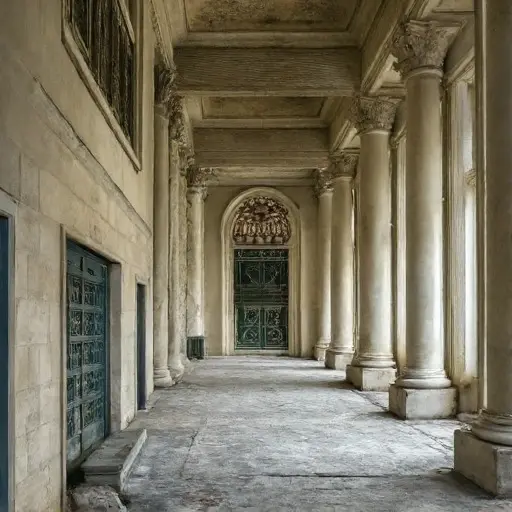
By the late 1920s, the Montevaldo Palace began to experience financial strain as administrative centralization reduced the importance of private estate governance and trade revenues declined. Maintenance of its highly regular neoclassical façade required continuous skilled labor, particularly for stone cleaning, ironwork preservation, and ceramic panel restoration. As income decreased, portions of the residence were closed to reduce heating and staffing costs, leading to uneven occupation across the otherwise symmetrical structure. Unpaid correspondence accumulated, including tax notices and lease disputes that remained unanswered in office chambers. Moisture from the surrounding forest began to infiltrate stone joints and balcony fixtures, gradually softening the sharp contrast between ivory limestone, cobalt ceramics, and emerald ironwork. The estate slowly transitioned from active administrative hub to partially maintained residence with fragmented oversight.
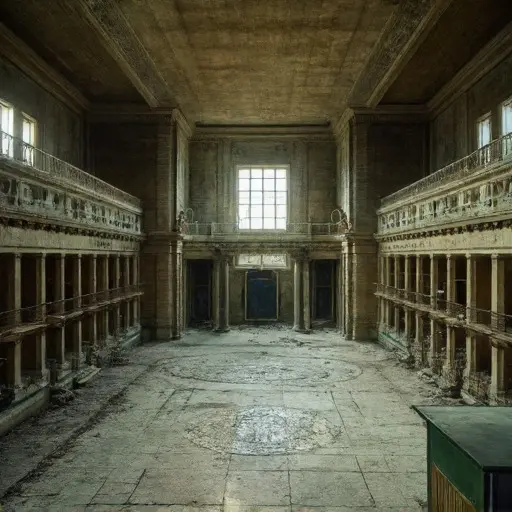
By the early 1940s, following prolonged financial collapse and unresolved inheritance fragmentation, the Montevaldo Palace was fully abandoned. No restoration efforts were undertaken, and legal disputes prevented any unified ownership or redevelopment of the estate. The structure remained embedded within the forest edge but deteriorated steadily under seasonal weathering, vegetation intrusion, and structural fatigue. Interior spaces were left in their final operational states, preserving furniture, documents, and household records beneath accumulating dust and humidity. Over time, the once disciplined Pombaline system dissolved into silent decay, leaving the palace as an uninhabited architectural remnant slowly reclaimed by forest growth and the passage of time.