The Wycliffe Cliff Manor Abandoned to Coastal Erosion
The Wycliffe Cliff Manor was completed in 1905 for maritime surveyor Edmund Wycliffe, who selected the exposed coastal cliff to oversee shipping routes and weather patterns along the northern shoreline. Built from pale chalkstone and red brick, the estate housed Edmund, his wife Sarah, and their son Jonathan, along with clerks responsible for compiling tidal records and maritime navigation logs. The manor’s heavy, grounded geometry was intended to resist the harsh coastal environment, with reinforced foundations descending into the cliff face and stone pylons anchoring it against erosion. In its early years, the house functioned as both residence and observation station, where weather data and shipping reports were recorded daily in rooms overlooking the restless sea.
<img src=”https://beyondvisit.
com/wp-content/imagecontent/uploads/abandoned victorian house 28575259.webp” alt=”” />
The observation room reflected Edmund Wycliffe’s structured approach to maritime study, but by the 1920s, shipping patterns began shifting toward larger commercial ports farther south. Demand for local coastal surveying declined, reducing income and limiting the estate’s operational purpose. Maintenance of the manor became increasingly difficult due to constant exposure to salt air and wind pressure. Stonework began to show early signs of mineral erosion, and sections of the seaward colonnade developed structural weaknesses that were initially monitored but not repaired due to rising financial constraints.
Erosion and Structural Strain
By the early 1930s, the Wycliffe family faced growing economic instability following Edmund’s retirement and declining survey contracts. Repair costs for the coastal manor increased significantly as salt damage accelerated deterioration of both brick and stone surfaces. The colonnade along the sea-facing side became unsafe and was partially cordoned off after several columns shifted under repeated storm stress. Interior rooms closest to the cliff edge were closed permanently due to moisture infiltration, leaving large sections of the estate unused and gradually decaying.
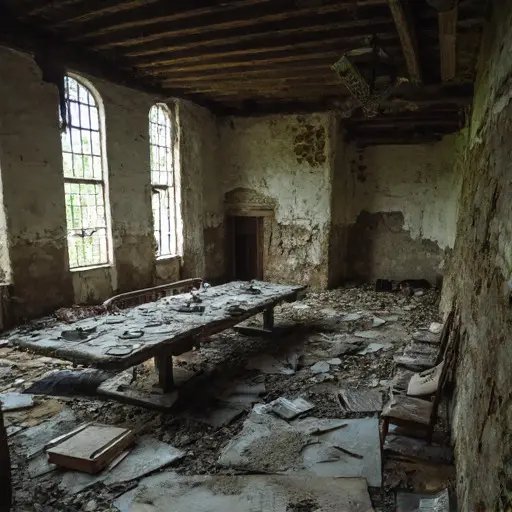
After Sarah Wycliffe’s death in 1936, inheritance disputes between distant relatives halted any coordinated maintenance of the estate. Legal proceedings prevented sale or restoration, leaving the manor in administrative limbo. With no caretaker, storm damage accumulated rapidly. Sections of the roof were torn away during winter gales, allowing seawater spray and rain to penetrate upper floors. Wooden interior structures warped under moisture, and salt crystallization spread through stone joints, accelerating fragmentation of the building’s core support systems.
Final Abandonment on the Cliff Edge
By the early 1940s, the Wycliffe Cliff Manor had been fully abandoned. No heirs returned, and no authority assumed responsibility for stabilization or repair. The seaward colonnade collapsed further, with remaining columns leaning precariously over the cliff edge. Interior corridors filled with debris carried by wind and rain, while broken windows exposed entire rooms to the elements. Continuous salt exposure and coastal erosion weakened the foundations embedded in the cliff face, causing gradual settlement and internal structural failure across multiple levels.
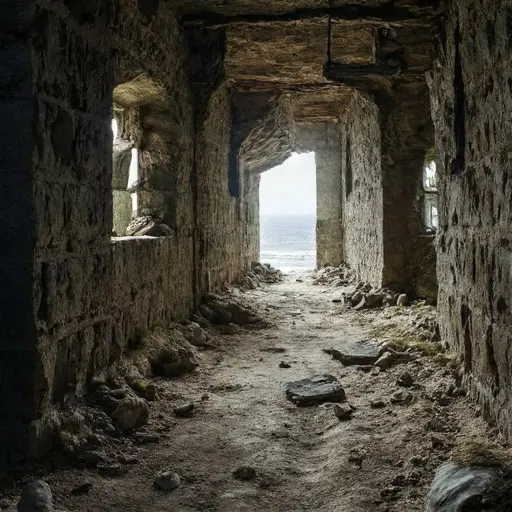
No restoration was ever undertaken, and no legal resolution returned the property to active ownership. The Wycliffe Cliff Manor remains standing on the coastal edge, slowly disintegrating under the combined forces of wind, salt, and erosion. Its interior spaces are permanently abandoned, with no remaining signs of habitation or repair, and its condition continues to deteriorate without intervention or recovery.