The Viremont Greenhouse Manor Left to Decay
Completed in 1912, the Viremont Greenhouse Manor was commissioned by botanical industrialist Henri Viremont, who sought to merge domestic life with experimental horticulture in a single glass-structured estate. Located in a sheltered forest basin, the residence housed Henri, his wife Delphine, and their daughter Elise, alongside horticultural staff responsible for maintaining rare plant hybrids and climate-controlled cultivation systems. The manor’s interconnected glass corridors and domed atriums created a continuous interior ecosystem, where light, humidity, and temperature were carefully regulated through iron-framed ventilation systems. In its early years, the structure functioned as both home and living laboratory, with daily life unfolding among thriving vegetation and reflective glass architecture.
<img src=”https://beyondvisit.
com/wp-content/imagecontent/uploads/abandoned victorian house 73827278.webp” alt=”” />
The atrium represented the harmony between architecture and cultivation, but by the early 1920s, economic instability began affecting the Viremont family’s industrial funding. Botanical supply contracts declined, and the cost of maintaining specialized glass heating systems increased significantly. Staff numbers were reduced, and several outer corridor wings were closed to conserve resources. Small fractures appeared in upper glass panels, initially repaired but later left untreated as financial pressures mounted. Moisture regulation became inconsistent, and certain plant zones began to overgrow their designated containment areas, signaling the first imbalance between design and upkeep.
Environmental Control Begins to Fail
By 1928, Henri Viremont’s declining finances forced partial withdrawal from active botanical research. Maintenance of the greenhouse systems became irregular, and sections of irrigation channels were abandoned. Without proper regulation, humidity levels fluctuated wildly, causing stress fractures in both glass panels and plant-support structures. Some atrium sections were permanently dimmed after storm damage shattered roof panes that were never replaced. The once-controlled ecosystem began to behave unpredictably, with invasive vegetation overtaking curated species and structural corrosion spreading across iron ribbing.
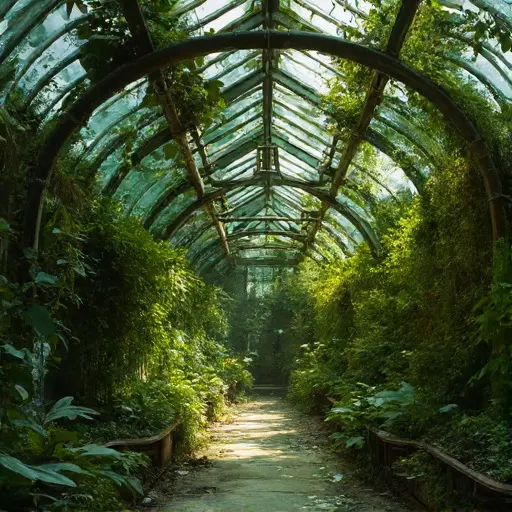
Following Delphine Viremont’s death in 1933, inheritance disputes divided control of the estate among distant relatives and financial administrators. Legal proceedings stalled any attempts at restoration or sale, leaving the greenhouse manor in prolonged uncertainty. With no unified oversight, maintenance ceased almost entirely. The central dome, weakened by years of stress and corrosion, began to sag inward. Sections of the botanical terraces collapsed into lower halls, and soil from overturned planters spread into interior corridors, merging cultivated space with uncontrolled vegetation growth.
Collapse of the Glass Ecosystem
By the early 1940s, the Viremont Greenhouse Manor had been fully abandoned. No heirs returned to assume responsibility, and no institution intervened to preserve the structure. The central dome collapsed further inward, bending iron ribs into fractured geometric shapes. Broken glass accumulated across interior floors, while wind and forest air entered freely through large structural gaps. Without climate control, humidity cycles ceased entirely, leaving plant life to decay, overgrow, or die in uneven clusters. The architectural boundary between interior and forest dissolved completely, turning the structure into an open skeletal ruin.
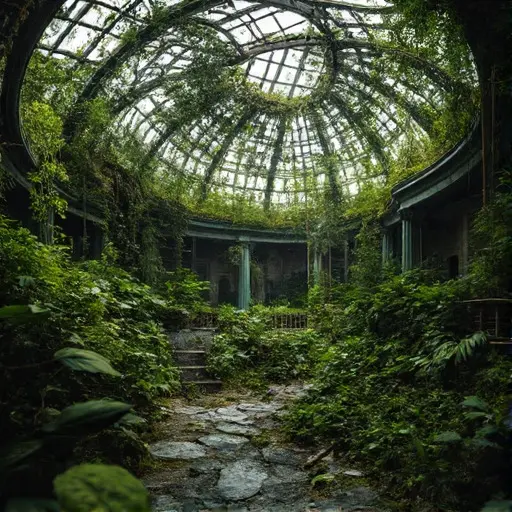
No restoration was ever attempted, and no legal resolution returned the estate to functional ownership. The Viremont Greenhouse Manor remains within the forest basin as a deteriorating glass ruin, slowly collapsing under vegetation, weather, and structural fatigue. Its interior ecosystems are permanently abandoned, with no remaining trace of human care or botanical management, and its condition continues to decline without intervention or recovery.