The Silent Mass of the Romanesque Forest Abbey-Fortress
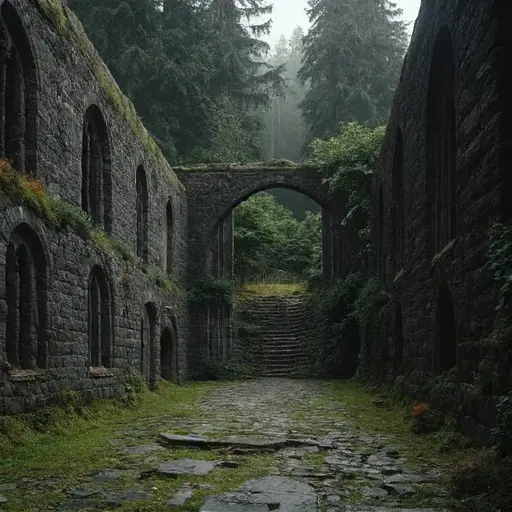
An abandoned Romanesque abbey-fortress sits deep within a dense pine forest, its presence defined more by mass and weight than by ornament or refinement. From a wide low-angle perspective, the structure rises as a compact monolithic volume of dark granite and volcanic basalt, its surfaces rough-hewn and uncompromising. The architecture feels carved rather than built, as if extracted from the earth itself and set into a deliberate, defensive geometry.
The composition is anchored by heavy rounded barrel vaults and deep-set semicircular arches that repeat in disciplined rhythm across the façade. Thick defensive buttresses press outward at intervals, reinforcing the sense of containment and structural endurance. Light barely penetrates the recessed openings, and what glass once existed has long since vanished or dulled, leaving the abbey visually sealed from the outside world.
The entire structure rests on a raised stone plinth that elevates it slightly above the forest floor, separating it from the encroaching vegetation below. Yet this separation is no longer absolute. Moss spreads across joints in the stonework, and ferns grow in the sheltered recesses of the architecture, softening the harshness of the basalt without diminishing its weight.
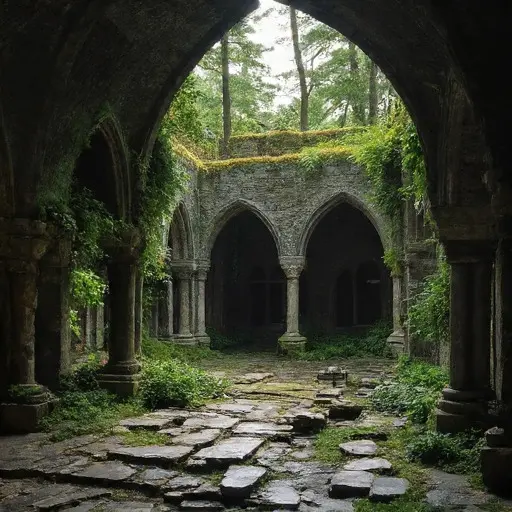
Inside the broken cloister perimeter, a partially collapsed arcaded walkway traces a fading rectangle around the courtyard. The arches remain structurally legible but fractured in continuity, with sections missing or slumped inward. Beneath them, stone flagstones are cracked and uneven, their original geometric order disrupted by root systems that push upward through joints and seams.
The courtyard itself has become a quiet ecological basin. Moss spreads in irregular carpets across the ground plane, while ferns and low vegetation fill the spaces between fallen stones. The Romanesque language of repetition and solidity remains visible in the surviving arches, but it is now softened by organic intrusion, creating a layered tension between permanence and decay.
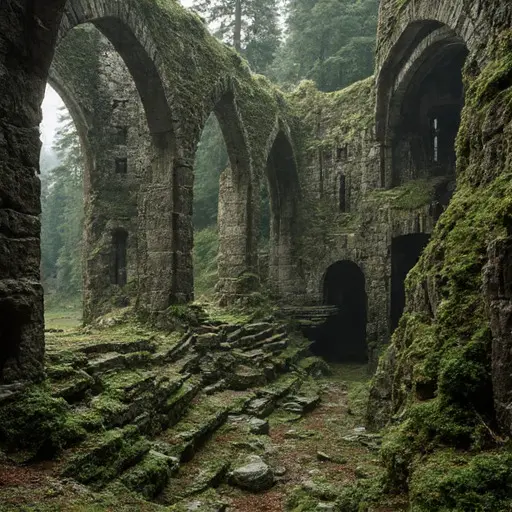
Beyond the cloister, the pine forest presses close to the abbey’s outer walls. Tall trunks rise in dense vertical repetition, echoing the rhythm of the buttresses while erasing the boundary between constructed fortification and natural enclosure. The forest does not overwhelm the structure violently; instead, it surrounds it with steady inevitability, tightening its presence against the stone perimeter.
Under soft neutral daylight and a clear, haze-free sky, the textures of granite, basalt, and weathered stone remain sharply legible. The scene is evenly lit, revealing every surface fracture, moss layer, and carved arch without dramatic shadow or atmospheric distortion. The clarity reinforces the architectural honesty of the structure, emphasizing material truth over mood.
The abbey-fortress stands as a relic of severe Romanesque intent—fortified, grounded, and enduring—now slowly integrated into the forest’s slower and more patient geometry.