The Silent Geometry of the Renaissance Forest Palazzo
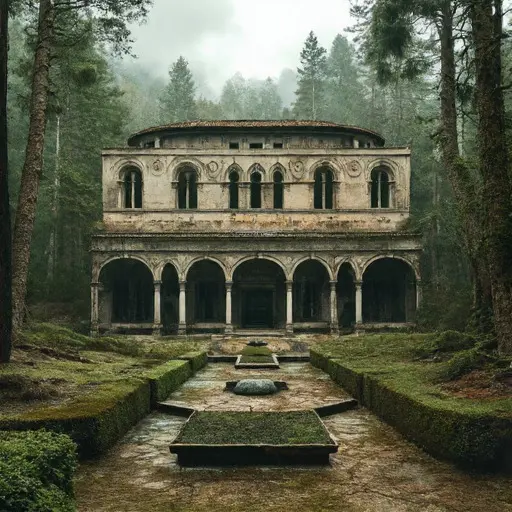
An abandoned Italian Renaissance palazzo-villa rests in a quiet forest clearing, its strict geometry still asserting order against the slow advance of nature. Captured from a low-angle ultra-wide 24mm perspective, the structure emphasizes symmetry, proportion, and disciplined classical balance. The 4-story composition rises from a rusticated stone base into refined upper levels of white stucco articulated by rhythmic pilasters, each vertical element reinforcing the Renaissance ideal of measured harmony.
Across the central façade, long arcaded loggias stretch in precise alignment. Several arches have collapsed over time, exposing shadowed interior corridors that recede into darkness. The absence of interior light reinforces the building’s abandonment—only natural daylight defines space, passing through broken archways and fractured openings to reveal depth without revealing life.
The roofline is flat and restrained, bordered by a weathered stone parapet and broken classical statuary. Unlike Gothic or Baroque estates, there is no vertical excess—only controlled horizontality and architectural clarity, now softened by age and creeping vegetation.
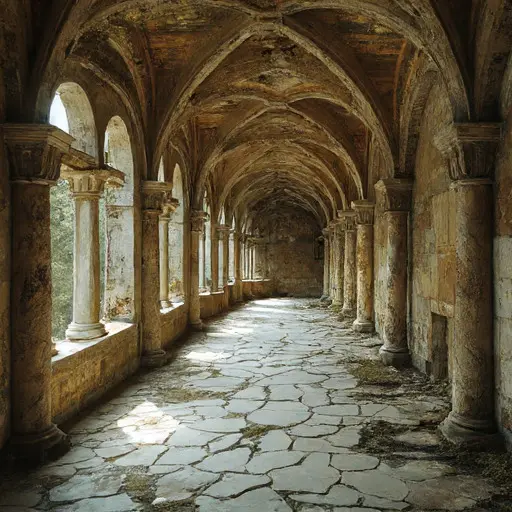
Inside the palazzo, long corridors extend along strict axial geometry. Arcaded loggias define the interior rhythm, their arches alternating between intact and partially collapsed forms. Corinthian pilasters support the upper structure, though time has softened their carved detailing. Faded cobalt fresco remnants still cling to sections of wall, hinting at once-vivid decorative programs now reduced to subtle pigment traces.
The interior remains entirely unlit. Light enters only through loggias, broken arches, and open courtyard-facing corridors, creating a calm gradient of illumination across stone floors. Cracks in the flooring allow moss to creep inward, subtly merging architectural precision with natural encroachment.
At the front of the estate, an overgrown formal hedge maze marks the entrance axis. Marble columns lie partially toppled, their bases swallowed by ivy and wild undergrowth. A cracked travertine courtyard extends inward, its geometric tiling still readable beneath layers of dirt and vegetation. At its center, a fountain basin sits dry, filled with moss and tall grasses instead of water.
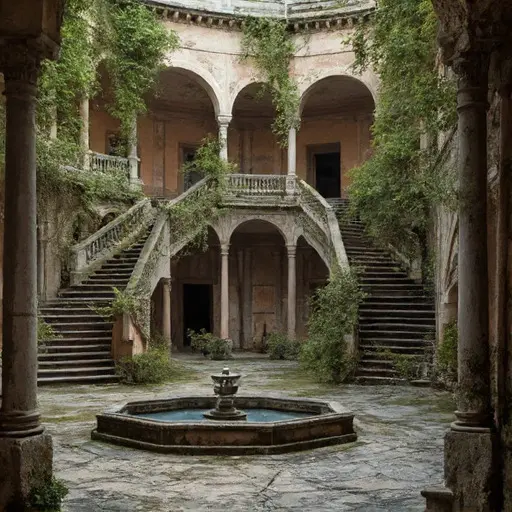
The grand portico rises at the center of the composition, framed by Corinthian columns stained by age and partially overtaken by climbing vines. Symmetrical double staircases ascend toward this focal point, reinforcing the palazzo’s disciplined axial design. Despite abandonment, the spatial logic remains intact, allowing the viewer to read the estate as a coherent architectural system.
Beyond the structure, dense deciduous forest presses directly against the villa’s perimeter. Tall beech and hornbeam trees rise close to the walls, encroaching upon former garden boundaries and dissolving the transition between cultivated and wild space. Layers of forest depth extend behind the palace, creating a gradual visual absorption of architecture into woodland.
The palette remains restrained and historically grounded: white marble, rusticated stone, antique brass fixtures, muted terracotta garden remnants, and traces of cobalt fresco pigment. Under soft neutral overcast daylight, the entire scene is evenly illuminated, emphasizing texture and proportion without dramatic contrast. The result is a cinematic study of Renaissance order preserved in decay—an aristocratic geometry slowly returning to the forest that surrounds it.