Faded Opulence of the Forest-Edge Château
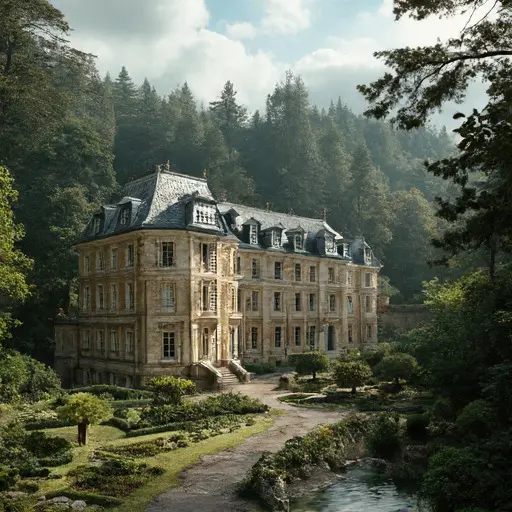
An abandoned French Baroque château sits at the threshold between dense European forest and the remnants of a once-formal aristocratic garden system. Captured in a low-angle ultra-wide 24mm perspective, the structure asserts sweeping horizontal grandeur through a perfectly balanced 3-story symmetrical composition. The elongated central corps de logis is flanked by curved pavilions, forming a continuous architectural rhythm that still reads with precision despite decades of neglect.
The façade is carved from warm cream limestone and enriched with Rococo reliefs that once signaled wealth and ceremonial prestige. Tall arched windows line the structure in strict order, framed in black wrought iron that now shows signs of oxidation and slight deformation. Above, a slate mansard roof runs the length of the château, punctuated by ornate dormer windows and bronze ridge ornaments dulled into muted green-brown tones. Ivy has begun to creep into joints and cornices, softening the otherwise disciplined geometry.
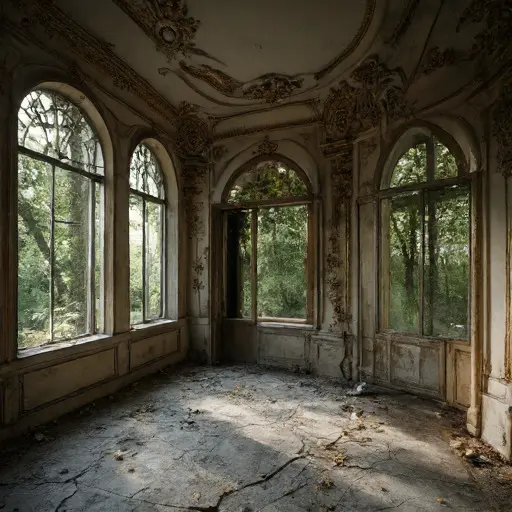
Inside the château, grand salons and reception halls remain structurally intact but entirely unlit. Natural daylight enters through tall arched windows, casting soft illumination across cracked marble floors and faded stucco ceilings. Ornamental moldings and Rococo detailing remain visible along walls and cornices, though their gilded accents have dulled into subtle traces of former opulence.
The atmosphere inside is silent and suspended. No artificial lighting survives, leaving only diffuse exterior light to define space and depth. The result is a series of layered interiors where architectural elegance persists even as occupancy has vanished entirely.
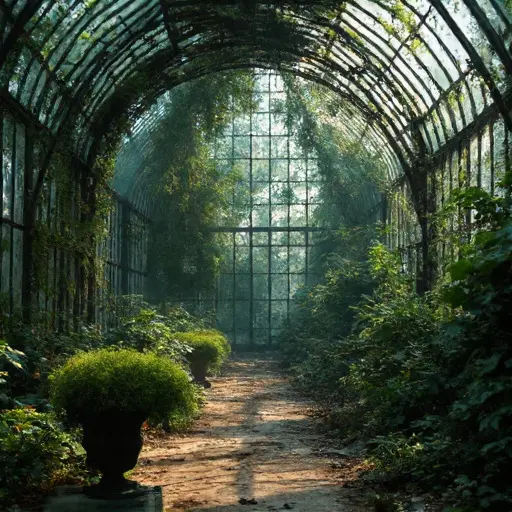
One wing of the château extends into a partially collapsed glass conservatory. Its iron framework remains intact in skeletal form, but fragmented teal-tinted panes have fallen or shattered, allowing vegetation to grow freely within the structure. Light filters through broken geometry, scattering across leaves, rusted metal ribs, and overgrown stone planters.
The foreground is dominated by cracked marble terrace steps overtaken by climbing ivy. Classical urns lie scattered along the edges, some tipped over and filled with moss, others still standing but softened by lichen and time. Overhanging branches and fragmented iron garden gates frame the composition, reinforcing the sense of layered intrusion between forest and estate.
At the midground, a dry ornamental canal cuts through the estate grounds, reflecting fractured fragments of sky and architecture in shallow, still surfaces. Broken bridges span sections of the canal, leading into parterre gardens that have become uneven fields of wild growth. The original geometry of hedges and paths is still faintly visible beneath overgrowth, like an architectural memory slowly dissolving into vegetation.
Beyond the gardens, dense forest presses inward. Tall beech and chestnut trees rise directly against the château’s perimeter walls, their vertical forms contrasting with the building’s horizontal symmetry. Roots disturb old stone edging, and branches obscure portions of the façade, signaling a slow but steady reclamation of aristocratic space by natural forces.
The palette remains restrained yet rich—cream limestone, sapphire roof accents, white marble statuary, and aged bronze detailing dominate the visual field. Under soft neutral daylight and a clear sky, the entire estate reads as a study in faded opulence: a place where engineered elegance persists not through preservation, but through the quiet endurance of form against time.