Silent Granite Order of the Nordic Clearing Manor
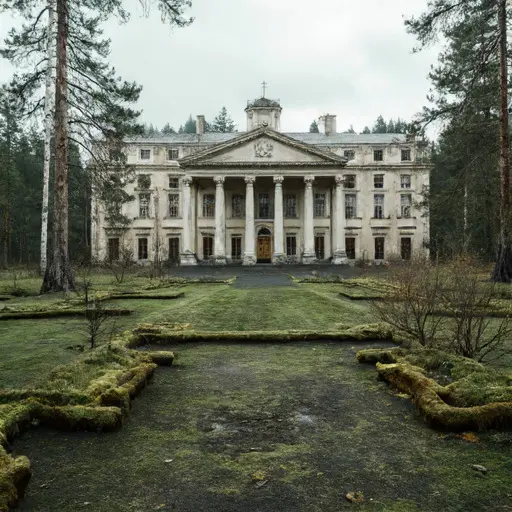
An abandoned Scandinavian Neo-Classical manor stands in disciplined silence on a raised forest clearing plateau, its rigid symmetry still asserting itself against the slow encroachment of wilderness. The structure is a strict 3-story composition, elongated and horizontal in its presence, composed of pale granite blocks paired with smooth white plaster surfaces that have softened slightly under time and weather. A long colonnaded façade defines the primary elevation, each column evenly spaced with mathematical precision, reinforcing the architectural philosophy of order and restraint.
At the center, a triangular pediment crowns the manor’s main axis, its sculptural relief eroded by decades of wind and rain until only faint classical forms remain readable. Tall arched windows punctuate the façade in perfect rhythm, their faded deep green wooden frames hinting at once-careful maintenance now lost to abandonment. The windows remain dark and inert, offering no interior glow—only depthless voids behind glass.
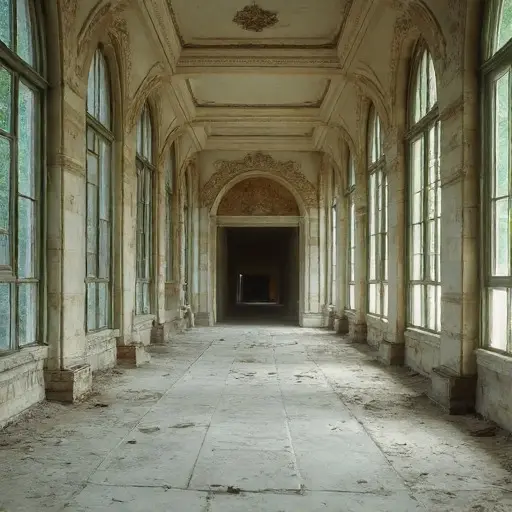
Inside, the manor resolves into a sequence of restrained classical halls aligned along a central axis. Stone floors run uninterrupted through the interior, their pale surfaces dulled by dust and organic debris carried in over time. White plaster walls rise with minimal ornamentation, emphasizing proportion over decoration. Through the tall arched windows, diffuse daylight filters in from the surrounding forest, casting soft, cool illumination across the empty interior spaces. The absence of any artificial light deepens the sense of abandonment, as if the building has been structurally preserved but emotionally vacated.
The manor’s flanking wings extend outward in balanced symmetry, terminating in minimalist pavilion blocks with flat copper-clad roofs now oxidized into a soft turquoise patina. These lateral volumes reduce ornamentation further, acting as quiet counterweights to the central colonnaded façade. Their geometry is restrained and functional, yet still aligned with the overarching neoclassical order of the estate.
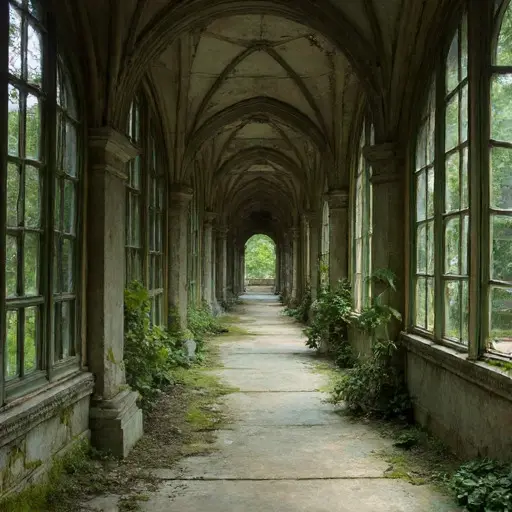
Outside, the formal gravel courtyard that once structured approach and ceremony has been overtaken by wild grasses and young birch saplings. The geometric order of the landscape is still legible beneath nature’s reclamation, with faint outlines of paths and planting beds dissolving into organic growth. A fragmented ceremonial driveway cuts through the forest, its pale stone surface broken and uneven as it disappears into dense pine and spruce stands.
The surrounding woodland presses tightly against the estate’s boundaries. Vertical tree trunks echo the vertical rhythm of the colonnade, while the horizontal massing of the manor contrasts sharply with the organic irregularity of the forest. Fallen logs and moss-covered stone boundary markers frame the foreground, reinforcing the sense of layered time—architecture, abandonment, and regrowth occupying the same space.
Under neutral overcast daylight, the entire scene is evenly illuminated without dramatic shadow or atmospheric distortion. The result is a quiet architectural tension: strict Nordic Neo-Classical order suspended within a living forest that slowly but persistently reclaims it.