The Sunwarmed Loggias of Villa Aurelia
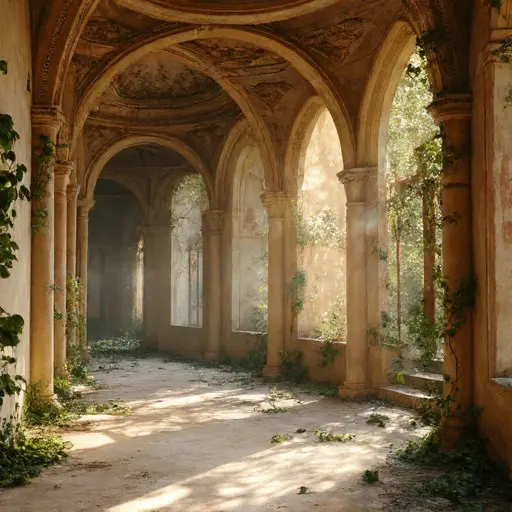
Abandoned Victorian family estate designed in an opulent Florentine Renaissance–garden palace style reinterpreted through soft organic geometry, situated in a wide forest clearing where the mansion feels like a cultivated artifact of extreme aristocratic taste slowly absorbed by nature. The structure rises 3 stories with a long, elegant horizontal composition anchored by two asymmetrical pavilion wings, connected through arcaded galleries and open loggia corridors that wrap around interior courtyards now partially overtaken by vegetation.
The exterior is constructed from warm honey-colored travertine, pale rose marble, and smooth ivory plaster, layered in alternating bands that emphasize horizontal flow rather than vertical dominance.
Decorative surfaces are restrained but refined: carved stone friezes of botanical scrollwork, soft stucco reliefs of classical figures, and inlaid marble borders in muted tones of olive green, dusty gold, and faded terracotta. The palette feels sun-warmed and aged, like a grand estate preserved in memory rather than decay.
The roof is composed of low terracotta tile slopes in deep burnt sienna and muted ochre, interrupted by elegant domed skylight lanterns and slender chimney stacks finished in weathered brick and soft stone caps. Subtle curvature runs through the rooflines, giving them a gently flowing silhouette rather than rigid angles. Copper drainage elements and ornamental roof edges have aged into a softened green patina that blends into the natural surroundings.
The central entrance is a broad arched portal framed by paired stone columns with simplified Corinthian detailing, leading into a deep recessed vestibule shaded by a heavy stone entablature. Massive double doors of dark walnut wood are carved with intricate but worn Renaissance patterns and accented with brass hinges and inset panels of frosted green and amber glass. Beyond the threshold is complete darkness with no interior illumination visible.
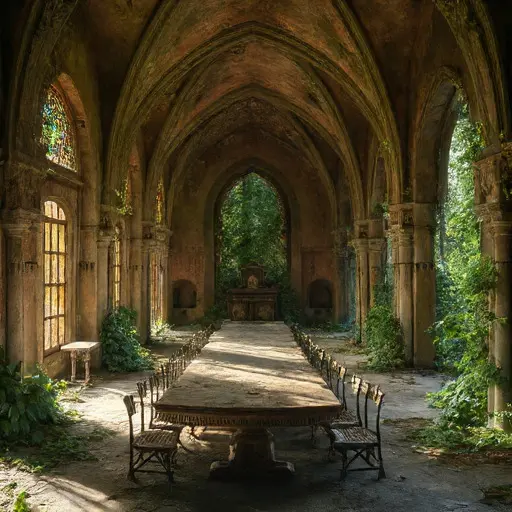
Windows are tall and elegantly proportioned, arranged in rhythmic sequences across the façade. Each opening is framed in carved stone with soft rounded edges and fitted with lightly tinted glass in muted shades of pale jade, smoky amber, and soft sapphire. Some windows extend into shallow arched loggia openings supported by slender columns, creating layered depth and shadow play across the exterior walls.
One wing of the mansion opens into a long cloistered garden arcade with repeating stone arches overlooking a sunken courtyard filled with overgrown citrus trees, ivy-covered statuary, and fragmented marble fountains. Another section features a glass conservatory framed in bronze and aged iron, its structure simple and elegant, allowing diffuse daylight to scatter softly across interior stone surfaces.
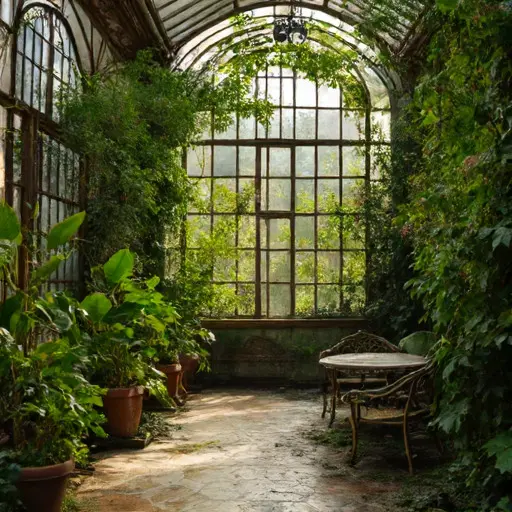
The surrounding grounds are a vast Renaissance-style estate garden now gently reclaimed by forest: symmetrical parterre outlines softened into natural curves, gravel pathways partially buried under moss, and circular fountains of pale stone now still and filled with fallen leaves. Vegetation grows in layered abundance—white roses, pale lavender, soft pink peonies, deep green ferns, and climbing ivy weaving through arches and stone balustrades.
The forest environment is calm, evenly lit, and serene under soft neutral daylight with no fog, mist, or dramatic weather effects. Foreground vegetation merges with marble and travertine fragments, midground centers on the honey travertine and rose marble Florentine Victorian estate with arcaded loggias and flowing terraces, and background dissolves into dense layered woodland depth. Materials are richly tactile and warm: travertine, rose marble, ivory plaster, terracotta tile, walnut wood, bronze ironwork, aged copper, and frosted glass, forming a completely distinct Victorian family estate defined by sun-warmed aristocratic elegance, gentle organic flow, and nostalgic garden grandeur reclaimed by nature.