The Sunflower Turret House in the Woodland Meadow
Tucked into a quiet woodland meadow where oak, maple, and birch trees form a soft green boundary, the abandoned Victorian Queen Anne family home stands with an enduring sense of warmth and playful elegance. Designed in the late 19th century as a cheerful domestic residence, the house embraces asymmetry, color, and ornamental variety rather than rigid formality, creating a structure that feels lively even in complete abandonment.
The exterior is clad in smooth sky-blue painted wooden siding resting on a solid white river-stone foundation, giving the home a bright, grounded presence. Above it, coral-colored fish-scale shingles fill the upper gables, adding texture and visual rhythm to the façade. The roofline itself is a dynamic composition of intersecting gables covered in burnt orange clay tiles, their warm tones contrasting vividly with the surrounding greenery and lending the structure a sunlit, almost nostalgic glow.
One of the most striking features is the three-story cylindrical corner turret, which rises gracefully from one side of the house. It is crowned with a sunflower-yellow conical roof trimmed in delicate white cresting, a whimsical detail that remains vivid even after decades of weathering. This turret acts as a visual anchor, balancing the otherwise playful asymmetry of the residence.
The front façade is defined by a broad L-shaped veranda that wraps around two sides of the home. Slender white turned columns support the porch roof, linked by mint-green spindle railings and intricate lace-like fretwork that still displays remarkable craftsmanship. Wide wooden steps lead up to the entry, where teal-painted double doors stand beneath a sheltered porch. Their oval stained-glass panels—blending coral, turquoise, and golden yellow—are cracked and dulled, yet still catch fragments of daylight. Behind them, the house is entirely dark, with broken or missing window panes revealing only silence.
Large stained-glass bay windows project outward from both the front and side elevations, while a small second-floor sleeping porch with decorative arches overlooks the overgrown garden below. Dormer windows along the attic level are trimmed in coral and cream, adding another layer of color to the already vibrant roofscape. Three tall cream-colored brick chimneys rise through the orange tiles, their surfaces softened by moss and age but still structurally proud.
The surrounding garden retains the memory of a once-loved family landscape. White stone paths wind through clusters of overgrowth, occasionally disappearing beneath grasses and wildflowers. A small dry fountain of polished turquoise marble sits at the center, now surrounded by scattered ceramic planters and flowering shrubs that have grown freely into their own arrangement. Bright pink roses, orange lilies, blue delphiniums, white daisies, and lavender spill across the grounds in natural abundance, softening the geometry of the original design.
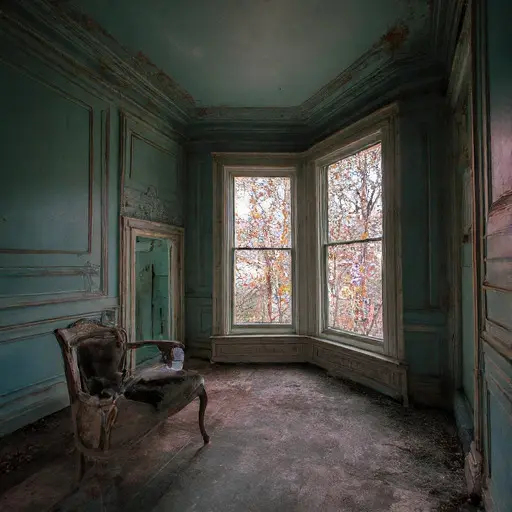
A low white picket fence, once carefully maintained, now leans and breaks apart as it follows the edge of the property before dissolving into ferns and tall grasses. Beyond it, the forest remains calm and protective, its canopy filtering soft neutral daylight across the scene. No fog, mist, or dramatic weather disturbs the clarity of the composition, allowing every material—painted timber, river stone, clay tiles, stained glass, wrought iron, and carved wood—to remain fully legible.
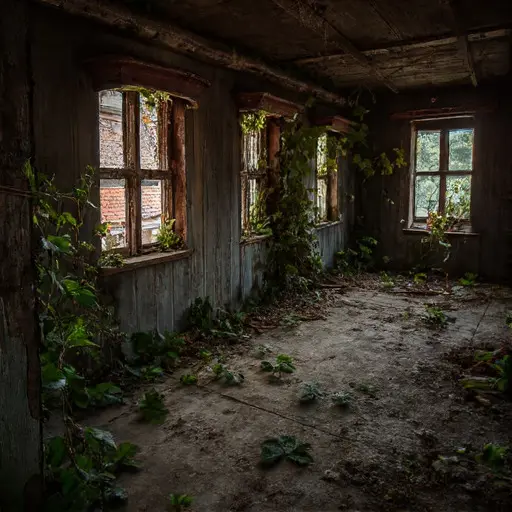
Though long abandoned, the house retains its joyful architectural identity. The combination of sky-blue siding, coral gables, sunflower-yellow turret roof, and mint-green veranda details creates a palette that feels almost musical in its harmony. Rather than fading into melancholy ruin, the residence persists as a vivid reminder of domestic optimism preserved within the quiet stillness of the forest meadow.