The Apricot Belvedere Italianate Villa
Hidden within a quiet woodland where tall deciduous trees filter soft daylight through layered green canopies, the Apricot Belvedere Villa stands as a graceful reminder of Victorian prosperity expressed through comfort rather than excess. This abandoned Italianate family home was never meant to dominate the landscape, but to sit within it—an elegant 2-story residence shaped by proportion, light, and domestic warmth. Even in abandonment, it retains a refined dignity, as though the house is simply waiting for a family that will never return.
The structure is defined by smooth pale apricot stucco walls resting on a low foundation of light gray granite, giving it both visual warmth and grounded stability. Crisp ivory stone trim outlines every edge, window, and architectural transition with careful precision, highlighting the disciplined symmetry that defines Italianate design.
Above, a gently sloping roof of glazed turquoise ceramic tiles introduces a subtle vibrancy, its reflective surface softened by age yet still catching fragments of sky-colored light through the forest canopy.
A modest square belvedere tower rises above the main roofline, serving as the villa’s most distinctive feature. Its shallow hipped roof and tall arched windows once offered views across cultivated gardens and distant hills, now replaced by dense woodland. Though weathered, the tower still anchors the composition, giving the house a vertical accent without disrupting its calm residential scale.
The front façade unfolds in balanced layers, anchored by a broad covered veranda that stretches nearly the full width of the home. Slender ivory columns support the overhanging roof, connected by delicate wrought iron railings painted deep bottle green. Over time, the paint has softened and dulled, but the intricate ironwork remains intact, preserving the elegance of its original craftsmanship.
The double front doors are crafted from polished walnut wood, still rich in tone despite decades of exposure. Their etched stained glass panels—floral patterns in sapphire blue and golden amber—have fractured in places, yet continue to scatter muted color whenever daylight passes through the porch.
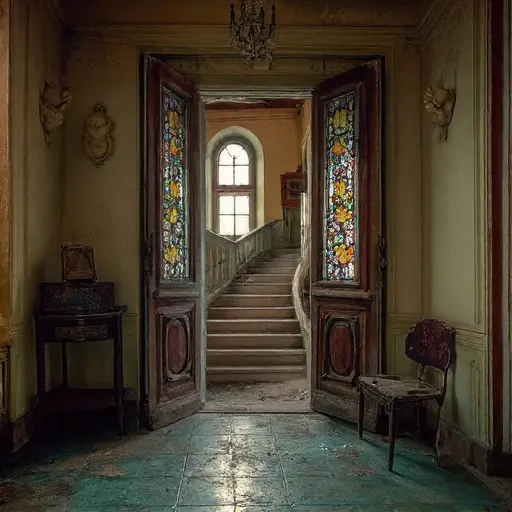
Inside, the villa is entirely silent. No artificial light remains, and every interior space is defined only by the soft intrusion of daylight through broken or open windows. Dust coats polished wooden floors, plaster walls, and decorative cornices, while empty rooms retain their architectural clarity. Fireplaces stand cold and untouched, hallways stretch into shadow, and staircases rise with quiet elegance, preserving the memory of everyday family life rather than grandeur or opulence.
Tall paired arched windows line both floors of the façade, each framed by decorative stone lintels and subtle molded cornices. Some panes remain intact, while others are cracked or missing, allowing ivy and wind to subtly interact with the interior spaces. A projecting bay window on one side adds depth and rhythm to the exterior, its turquoise tile panels beneath the glass reflecting faded hints of color even through neglect.
Two cream-colored chimneys rise from opposite ends of the roof, their brickwork softened by time and weather. Clusters of jasmine and ivy climb gently around veranda columns and lower walls, never overwhelming the architecture but instead weaving themselves into its structure like quiet companions.
The surrounding garden still reveals the careful planning of a Victorian family residence. Curved limestone pathways wind through overgrown flower beds filled with red camellias, blue hydrangeas, white lilies, foxgloves, and dense emerald ferns. At the center stands an octagonal marble fountain, long dry, surrounded by cracked mosaic paving in faded teal, ivory, and terracotta tones.
A low wrought iron fence encircles the property, its open gate partially hidden by flowering shrubs and moss. Beyond it, the forest remains calm and balanced—tall beech, oak, and maple trees forming a natural enclosure that feels protective rather than consuming.
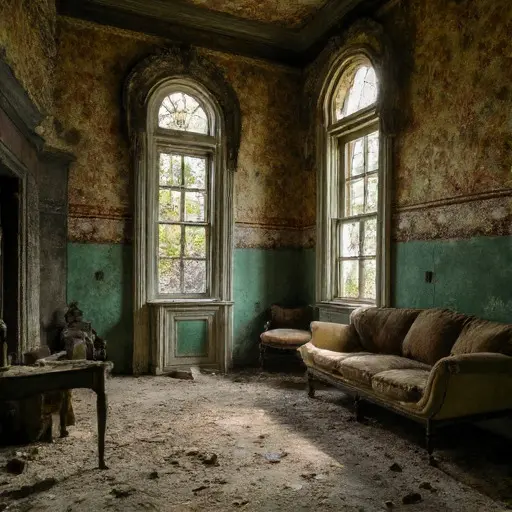
The villa’s materials continue to age with quiet elegance. Stucco has softened into warm pastel tones, ceramic roof tiles display subtle variations of turquoise and sea-green, walnut wood deepens into rich brown patina, and wrought iron retains its delicate structure beneath a layer of time. Every surface reflects craftsmanship designed for longevity rather than spectacle.
Today, the Apricot Belvedere Villa remains a tranquil fusion of architecture and woodland. It does not feel destroyed, only paused—its life suspended between memory and nature. Surrounded by forest and softened by years of quiet growth, it stands as a timeless Victorian family home, where elegance, comfort, and craftsmanship continue to exist even in silence.