The Vermilion Edge Manor at the Heathline
Exterior Structure
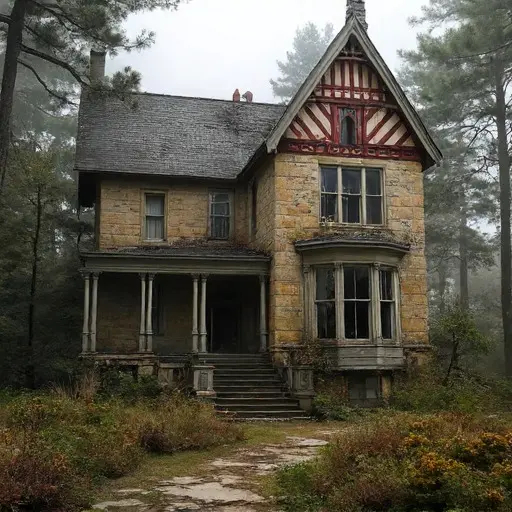
An abandoned Victorian family manor stands at the edge of a forest-heath transition zone, designed as a compact 2-story residence with sturdy rural elegance and practical symmetry. The structure is built from pale sandstone blocks combined with vermilion-red painted timber framing, producing a strong but grounded Victorian identity that remains visually legible despite long abandonment.
The roof is a steep slate-gray gabled system with multiple intersecting peaks.
Subtle bargeboards trace the edges of the gables, now softened by weather and time. The rooflines show slight irregularities, suggesting gradual settling rather than abrupt collapse.
The front façade is organized around a centered wooden entry door painted deep forest charcoal. A modest stone arch frames the doorway with minimal carved detailing, prioritizing structure over ornament. A shallow covered porch extends outward, supported by squared sandstone pillars with chamfered edges, giving the entrance a restrained but solid presence.
Above the entry sits a single rectangular second-floor window aligned vertically. Its smoky-green glass is cracked and partially missing, revealing a dark, unlit interior. Across the façade, tall narrow sash windows are fitted with white-painted frames, irregularly spaced due to incremental extensions added over time.
Interior Quietness
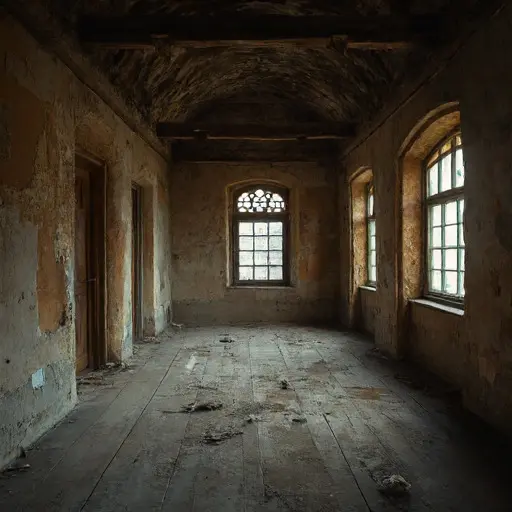
Inside, the manor is quiet and structurally intact, defined by simple domestic rooms arranged in a functional layout. Walls alternate between exposed sandstone and aged plaster, revealing the layered construction typical of rural Victorian homes.
Timber beams cross ceilings in steady, utilitarian patterns, while wooden floorboards show long-worn paths softened by time. Light filters weakly through broken smoky-green windows, scattering muted illumination across dust-covered surfaces.
Doorways connect modest rooms without grandeur, reinforcing the sense of a practical family residence rather than an aristocratic estate. The interior feels paused, not destroyed—an inhabited space now emptied but still fully legible.
Grounds and Heath Reclamation
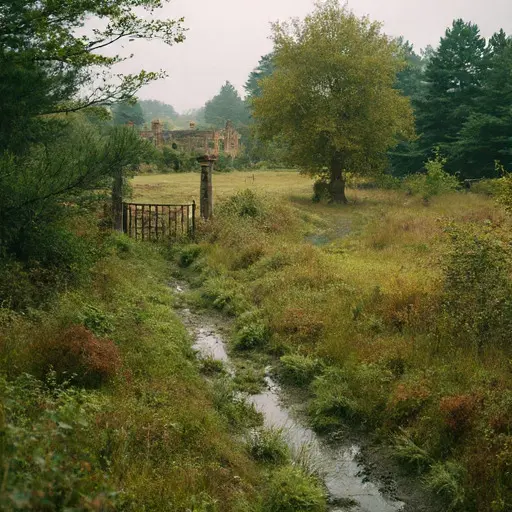
The surrounding grounds form a reclaimed heath-garden that gradually merges into forest ecology. Former Victorian planting beds are now broken into organic shapes, overtaken by grasses and heather-like vegetation.
A fragmented stone pathway runs diagonally through the landscape, partially buried beneath tall grasses and wild growth. It leads toward a rusted iron gate that is slowly being swallowed by shrubs and encroaching foliage.
Low stone borders remain scattered across the terrain, faintly outlining where structured flower beds once existed. The forest-heath boundary is gentle and natural, with open grassy patches blending into denser woodland without abrupt transition.
The manor remains clearly visible as the central anchor—quiet, grounded, and structurally intact—an abandoned Victorian family home preserved between heathland openness and forest encroachment.