The Plum Cottage on the Quiet Slope
Exterior Overview
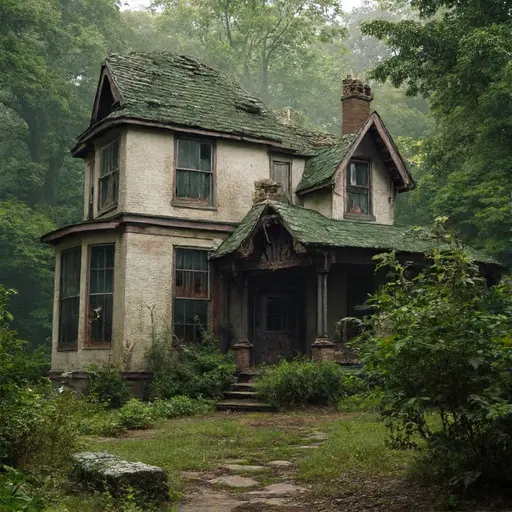
An abandoned Victorian family hill cottage rests in a gentle forest slope clearing, designed as a compact 2-story rural residence with simple elegance and carefully balanced proportions. The structure is built from pale cream stucco walls contrasted with plum-colored painted timber accents, giving the home a distinct yet softened identity that still reads clearly despite long abandonment.
The roof is a medium-steep sage-green shingle system with uneven Victorian gables, small decorative vergeboards, and slightly sagging lines that hint at years of weather exposure.
The overall silhouette remains stable and grounded, but gently softened at the edges by time.
The front façade centers on a modest wooden entry door painted muted plum, framed by a shallow arched porch with cream-painted timber supports and a simple triangular pediment above. The composition feels domestic and welcoming, even in its abandoned state.
Above the entry, a single narrow second-floor window sits slightly off-center, accompanied by a small iron Juliet balcony with faded dark bronze tones. Across the façade, tall casement windows with cream frames contain faint greenish antique glass—many panes cracked or missing—revealing deep, unlit interiors that hold no glow.
Interior Stillness
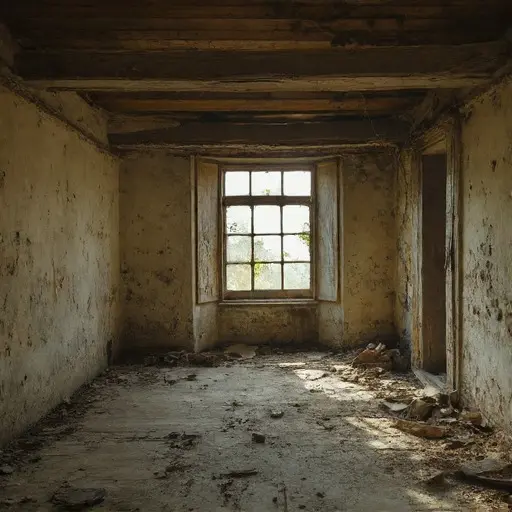
Inside, the cottage remains structurally intact but entirely emptied of life. Rooms are defined by soft cream plaster walls, exposed timber framing, and aged wooden floors worn smooth at their centers. Light filters through broken casement windows, scattering across dust-laden surfaces in muted patterns.
Doorways connect small domestic rooms in a simple, functional layout. The atmosphere feels paused rather than destroyed—an everyday household frozen at the moment of departure, still intact in shape but hollow in presence.
Grounds and Garden Reclamation
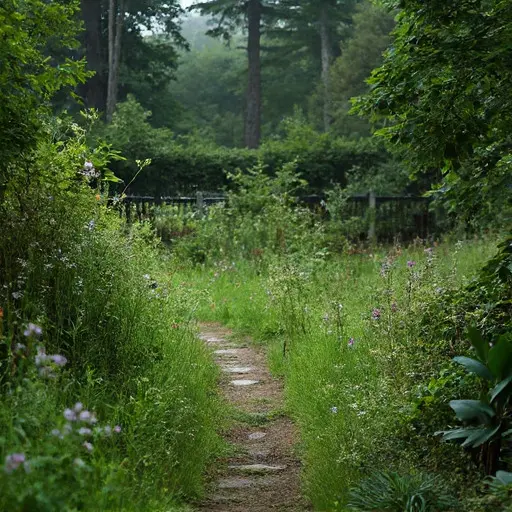
The surrounding garden is softly overtaken by nature while still preserving traces of Victorian design. Curved flower beds edged with broken stone remain faintly readable beneath creeping vegetation. A half-collapsed wooden fence, once cream-painted, now fades into weathered gray as it leans into tall grasses.
A winding dirt path leads from the cottage into the forest, gradually dissolving into moss, ferns, and wild growth. Wildflowers in lavender, pale yellow, and white scatter across the undergrowth, blending cultivated intention with natural reclamation.
The forest itself is dense but calm, composed of layered deciduous trees under soft, neutral daylight. No fog or dramatic atmospheric effects are present. The cottage remains quietly visible as a stable, modest structure—still standing, still readable, and gently absorbed into the hillside woodland.