The Hollow Briarwood House
Exterior Presence
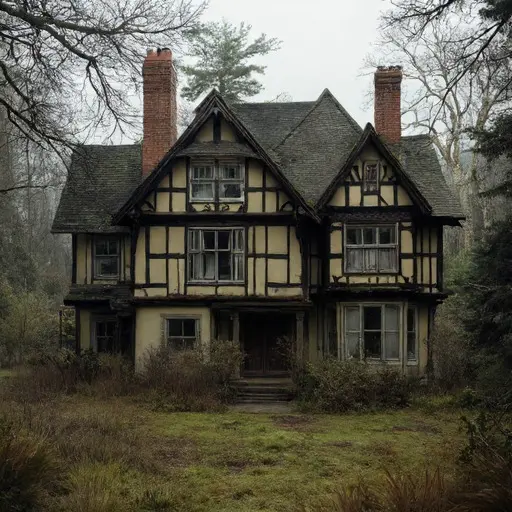
A fully framed abandoned Victorian family manor rests within a quiet forest glade, designed as a grounded 2-story timber residence that balances rural practicality with restrained decorative charm. The structure is composed of exposed dark oak beams forming a precise half-timber grid, filled with softened cream plaster panels that have weathered into warm, uneven tones of ivory and beige.
The roof is a steep olive-green slate gable system with irregular ridgelines, aged dormers, and faint wooden ridge ornaments worn smooth by time.
Its silhouette is asymmetrical but stable, giving the impression of a house shaped by long use rather than strict architectural planning.
At the center of the façade sits a slightly offset crimson-red arched doorway, its color still vivid against the muted timber surroundings. A modest veranda extends along one side, supported by carved wooden posts that lean subtly outward, as if adjusting to decades of seasonal ground shift.
Tall casement windows line the exterior in uneven rhythm, fitted with diamond-pane glass in faint amber tones. Many panes are cracked or missing entirely, revealing deep, unlit interiors with no glow or reflection—only darkness preserved behind old domestic walls.
Interior Atmosphere
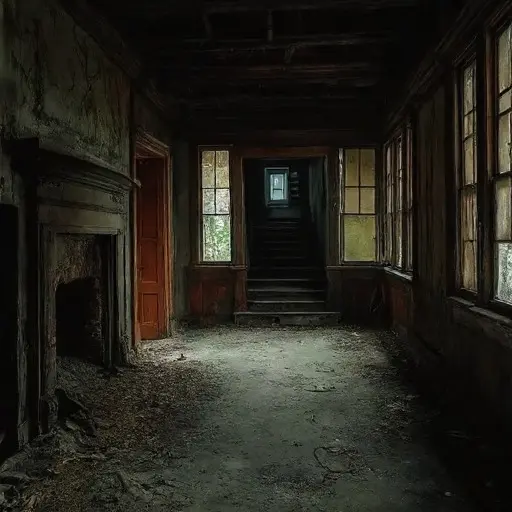
Inside, the manor feels hollowed but structurally intact. Wooden beams cross the ceilings in heavy, honest lines, while plaster walls peel in soft layers revealing older construction beneath. The floors are wide plank oak, worn smooth in the center as if shaped by years of foot traffic that no longer exists.
Rooms remain unfurnished, holding only architectural memory—fireplaces of soot-darkened brick, empty doorframes leading into shadowed adjoining spaces, and staircases that creak visually even in stillness. Light enters only through fractured windows, scattering weak patterns across dust-covered surfaces.
Grounds and Abandonment
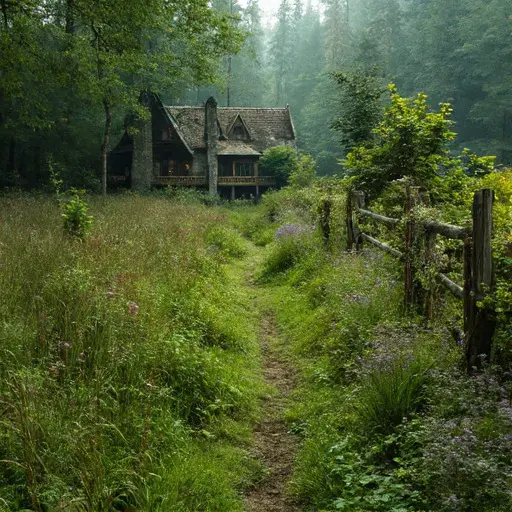
The surrounding yard forms a soft transition between human intention and natural reclamation. A narrow dirt path winds through uneven grass toward the forest edge, partially hidden by creeping ferns and wild growth. Stone-bordered garden beds have collapsed into organic curves, filled with uncontrolled wildflowers and moss-covered stones.
A broken wooden fence leans inward at irregular angles, no longer marking boundaries so much as blending into the vegetation. The forest stands close but not overwhelming, allowing the manor to remain clearly visible as the focal point—quiet, abandoned, and gently absorbed into its environment.
The overall atmosphere is grounded and melancholic, emphasizing a modest Victorian family home that has not collapsed, but slowly exhaled into stillness within the forest.