The Driftwood Hollow Cottage Left Hidden Beyond the Inland Forest
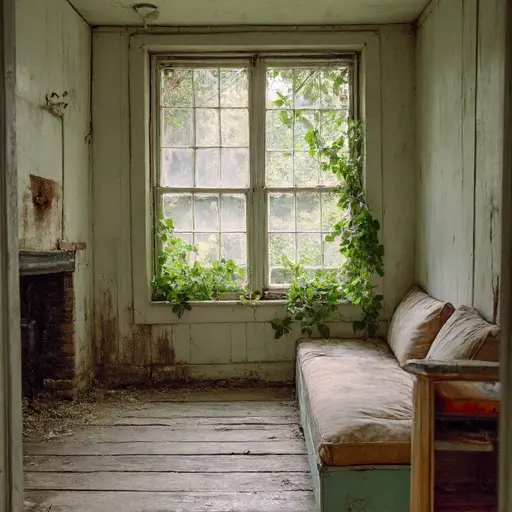
The Driftwood Hollow Cottage began as a seaside-inspired rural family home built in the late Victorian period, designed for a small household seeking a modest but comfortable residence away from the growing industrial centers. Though inspired by coastal architectural motifs, it was ultimately constructed inland within a forest clearing, where builders adapted maritime stylistic elements to a wooded rather than marine environment.
Its structure reflects this hybrid identity: pale sandstone blocks provide a grounded foundation, while white limewashed timber cladding introduces a bright, weather-resistant surface treatment.
The irregular multi-gabled roof with peacock-blue fish-scale shingles evokes coastal imagery, even as the surrounding landscape remains entirely forested.
The fading of coastal memory within inland stillness
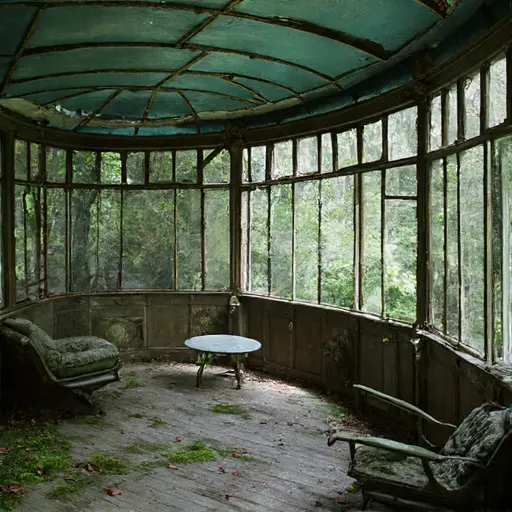
By the early 20th century, the cottage experienced gradual depopulation as younger generations moved toward coastal towns and urban centers, leaving the inland property without continuous occupancy. Seasonal visits became increasingly rare, and maintenance of the building’s more delicate architectural features began to decline.
The sunroom, once the most distinctive architectural feature of the house, suffered first from environmental wear. Its iron framing remained structurally stable, but the glass panels began to fracture and dislodge due to prolonged exposure and lack of repair. Over time, it transitioned from a bright domestic space into a semi-open structure where forest elements slowly entered and settled.
The quiet blending of forest and coastal design language
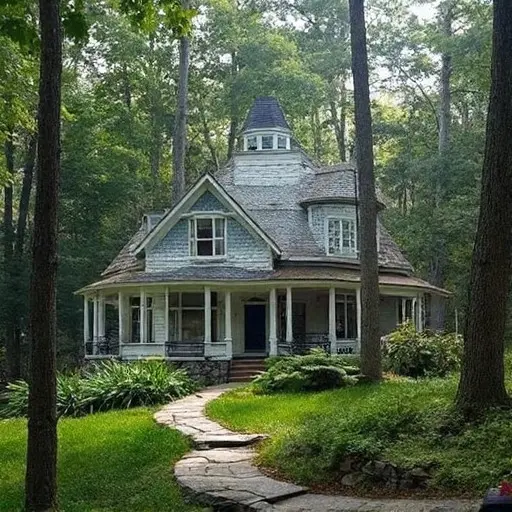
By the mid-20th century, the Driftwood Hollow Cottage had been fully abandoned as a family residence. No formal restoration efforts were undertaken, and the property gradually transitioned into passive forest reclamation while remaining structurally intact.
Today, the cottage stands quietly within the woodland clearing, its coastal-inspired architectural details softened by time and vegetation. It remains a small Victorian family home shaped by borrowed seaside aesthetics, now slowly returning to the inland forest that surrounds it in quiet equilibrium.