The Lyrienne Hexagonal Garden Palace Left Unattended After Botanical Order Dissolved
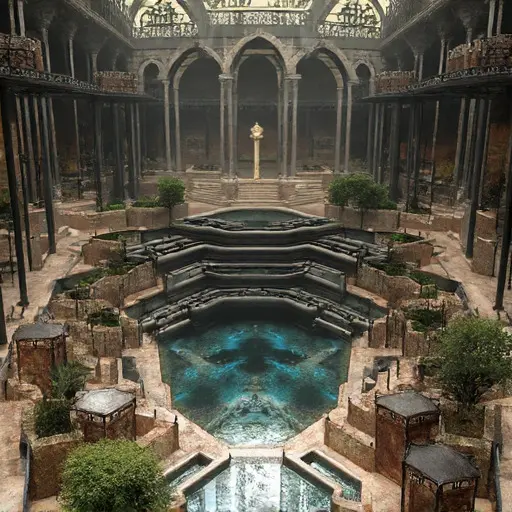
The Lyrienne Hexagonal Garden Palace was constructed between 1898 and 1912 as part of a privately funded horticultural and architectural synthesis project led by the Arcadie Botanical Society. Designed as a monumental terraced ziggurat, the structure was intended to merge controlled botanical environments with geometric spatial order, creating a living research environment embedded directly into architectural form. Built within a naturally sunlit forest clearing, the palace was carefully integrated into the terrain rather than imposed upon it.
Each hexagonal tier served a distinct ecological function, ranging from alpine flora cultivation on upper terraces to aquatic botanical systems surrounding the central sunken courtyard. Matte black steel frameworks supported bronze lattice canopies that regulated light diffusion, while basalt granite and terracotta stone provided thermal stability across seasonal shifts. The palace functioned as both research facility and contemplative garden space for visiting scholars, artists, and botanists.
The gradual cessation of cultivation systems
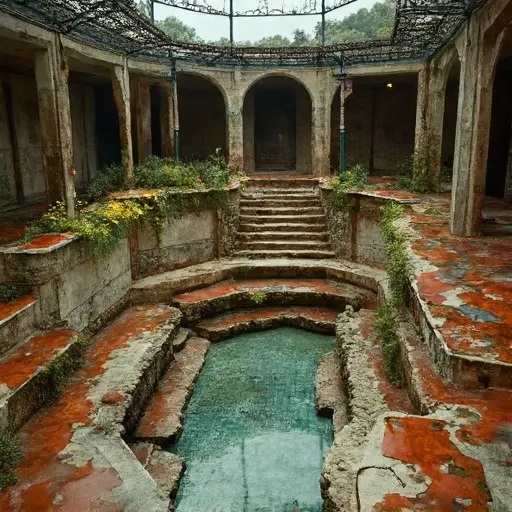
By the early 1930s, the Arcadie Botanical Society began to reduce funding for large-scale architectural cultivation projects in favor of more compact greenhouse research systems. As operational budgets tightened, the Lyrienne Palace experienced a gradual reduction in active maintenance personnel and environmental control oversight.
Irrigation channels serving the terrace gardens were slowly shut down, and lighting calibration systems within the bronze lattice canopies were deactivated. Without active regulation, several ecological zones shifted beyond intended parameters. Aquatic systems in the central atrium stabilized into still reflective basins, while upper terraces transitioned into semi-wild botanical states dominated by resilient flowering groundcover and moss growth.
The quiet return of geometry to nature
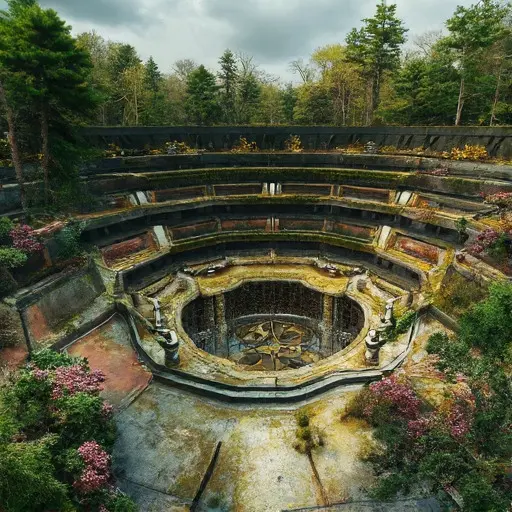
By the late 1940s, the Lyrienne Hexagonal Garden Palace had been fully decommissioned following the dissolution of the Arcadie Botanical Society. No successor institution assumed responsibility for its maintenance, and ownership records were gradually absorbed into broader land registry revisions without active enforcement.
The surrounding forest remained stable and respectful of the clearing, allowing the geometric terraces to remain fully exposed rather than overtaken. The palace persists as an abandoned terraced ziggurat of botanical architecture, where precise geometry and slow natural reclamation exist in quiet balance, forming a silent monument to a system of cultivated order that gradually dissolved into stillness.